

Ignatius J. Reilly VS Basil Marceaux
(A Confederacy of Dunces) (Future Tennessee Governor?)
Ignatius J. Reilly VS Basil Marceaux
(A Confederacy of Dunces) (Future Tennessee Governor?)
Filed under books
A first for Bookish! I’ve been given the opportunity to do an advance review of Inside-Out Simplicity: Life-Changing Keys to Your Most Important Relationships by Joshua Becker of Becoming Minimalist, an e-book that goes on sale Monday.

One of the people I wish I was more like is my friend Dana. Instead of having home internet access or the latest technological gadgets, she saves her money to pay for her vacation, which she usually spends helping people in Africa. She quietly makes her way through the world, living life as an opportunity instead of a battlefield, open to everything and easily befriending everyone. Despite my being a little hesitant around the many pastors’ kids who went to my suburban high school, my friendship with Dana has only grown stronger in the almost 15 years since we graduated. Dana was on my mind while I read Inside-Out Simplicity: Life-Changing Keys to Your Most Important Relationships, as she highly exemplifies most of the contents.

I however have a very long way to go.
The book structures its recipe for contented living from the inside out, reminding us in the beginning that having a good relationship with ourselves is the solid foundation for having positive relationships with others. This is a problem, as my relationship with myself has traditionally been rocky at best. Perhaps this provides the reader some insight on the grasp I have of the levels above this foundation.
Yipes.
Spouses, children, your relation to your possessions, even your relationship to a higher power, it’s all here. While much (but not all) of the content will be familiar to regular readers of Becoming Minimalist, organizing it in this way provides a good reference for self-improvement, or at least self-examination. If you’re overwhelmed by all the improving you’d like to see in yourself, just try to start working inside first. Or decide to try out one idea that sounds easily attainable, like volunteering or donating some money to a worthy cause. See what happens.
As an extra challenge, consider examining the questions that come up in your mind as you read the book. Haven’t donated for a while?–Why? How is volunteering supposedly rewarding? If you’re like me, you may discover you have a lot of work ahead of you to be the well-adjusted, happy person you want to be. While none of us are perfect, living with intentionality for the first time is a huge step towards feeling fulfillment on a daily basis.
The book aims to inspire and challenge the reader. Certainly I was challenged–slightly horrified, even, while finding myself questioning whether a huge life change I’ve spent the last year preparing for (and am about to make) wasn’t the wrong thing–whether the source of my unhappiness wasn’t quite what I thought it was. Guess you could say I wasn’t really prepared for the scope of this book.
But now that I’ve gotten gotten a toehold on the material possessions weighing me down, and my schedule for the next couple of years is pretty focused, it seems that this is the next frontier: using this list as a guide to try and achieve happiness.
Working from the inside, out.
Filed under books

David Sedaris makes me laugh almost as much as his sister Amy, whose book I blogged about last year. Ever since his story “The Santaland Diaries” first aired on This American Life in 1992, he has been the literary darling of NPR.
And it’s no wonder–Sedaris is deliberate about reading his work, taking detailed notes of audience reactions to consistently improve both his writing and delivery. His distinctive voice reminds many of Truman Capote, whose short story “A Christmas Memory” is often performed at theaters paired with “The Santaland Diaries.”
Here are my top five favorite David Sedaris stories. But you don’t have to take my word for it! Click on the story title to listen to David reading each piece himself!
5. “Jesus Shaves“ (Me Talk Pretty One Day)
At heart, this is a story about culture shock. A class full of international students learning French tries to discuss their different experiences of the same holiday, using limited skills in their new language.
4. “Stadium Pal“ (Appeared in Esquire)
A wish to accessorize leads David to try out the Stadium Pal, an external catheter/leg bag system.
3. “The Drama Bug“ (Naked)
“The drama bug strikes hardest with Jews, homosexuals and plump women who wear their hair in bangs.” As a high school theater nerd and Shakespeare-phile, this story makes me blush. Sedaris gets the details spot on, and I never get tired of listening to this piece. In fact, I even make an appearance in this story as David’s friend Lois.
2. “Poems About Dogs“ (Appeared in Esquire)
[Unfortunately, I can’t find a spot online to listen to David reading this one. If you ever come over to my house though, I have it on CD and I’ll play it for you!]
Sedaris has written a series of jovial poems to share the less glamorous parts of dog ownership with the rest of the world. Or maybe he just hates dogs. Either way, it’s hilaaaarious.
1. “You Can’t Kill the Rooster“ (Me Talk Pretty One Day)
David’s brother Paul is the star of this story, although Amy makes a cameo as well. Rather than describe it, you just need to experience it with David imitating his brother. Paul operates a website, and Amy’s book I Like You: Hospitality Under the Influence includes a recipe for the Fuck-It Bucket.
BONUS TRACK! Billie Holiday
David is fairly well known for his impersonation of Billie Holiday. This is a segment from another great story, “Giant Dreams, Midget Abilities” (Me Talk Pretty One Day). You will never hear the Oscar Meyer jingle the same way again.
Filed under books
Bookish has been rather quiet the last couple of months, and might continue to be quiet moving forward. That’s because I’m preparing for some pretty big changes in my personal life, including moving to a different country(!) and starting a master’s program.
This has been a long time in the making–I was originally going to apply to the program at the end of 2007. It was at this time total lunacy started breaking out at my former employer, and if it wasn’t directly related to my job it pretty much didn’t happen–and even if it was related to my job (like keeping mentally healthy or getting enough sleep) often it still didn’t happen. Good times.

Anyway. Between the prerequisite books I’m to read before stepping foot inside the classroom in September, boning up my Adobe skillz as required, and trying to prepare for life in a new land, it is time for Summer School at Bookish HQ. (Sadly, not the kind that includes trips to Venice Beach and a German shepherd wearing sunglasses.)
Here are the books I am currently reading, or will be reading in the next two months:

• Adobe InDesign CS4: REVEALED (It’s maaaagic!)
Last week I started an InDesign course at PCC, and we’re using this as a textbook. Interesting class. My mom and I thought we were choosing a traditional class over an online course, but our class is very non-traditional. Three classes–Intro to Word, Intro to Excel, and InDesign, are all being taught simultaneously. The textbook, in tandem with a PCC course packet, guide you through the work, and the instructor is there for support and grading. Our class time–three hours on Wednesday night and six excruciating hours on Saturday–is mostly just computer lab time. Attendance is not necessary as long as you’re getting your work done and are keeping in touch with the instructor so he knows you haven’t died. As my mom and I are sharing class materials and I was very sleep-deprived last Saturday, I spent a good portion of our class time napping on the bench outside our classroom.

• Help For Your Shy Dog
Author Deborah Wood used to write the weekly pets column for The Oregonian. Her book seems to feature mostly moral support, rather than specific practical tips, for owners of fearful dogs. While I have not yet finished the book, my faith in working with Atticus on his fear has been renewed. I also recently discovered that Rescue Remedy is actually noticeably effective, which has definitely helped Atticus during fireworks season.
Unfortunately, Wood does not cover fear aggression very much, which is Atticus’ issue when he’s around other dogs. We still even have to keep him separated from Rain, the new puppy. He’s very slowly getting over his fear of her, but he will still growl if she gets too close to him. And because she’s a rambunctious 11 9 week old puppy who doesn’t understand warning growls, she will always get too close. They remain separated for now.

• Lonely Planet Canada
About two months ago I got an email that began, “Dear International Student.” I chuckled. Yes, technically I am an international student, but not really, right?
Then a few weeks ago I was trying to wade through the Citizenship and Immigration Canada website to determine whether or not I needed to apply for a visa as a US citizen. The language was different than the legalese I was used to, and their 1-800 hotline didn’t work outside of Canada. It started hitting me: while I could be standing in the middle of Canada and not feel terribly out of my element, it turns out that yes, Canada is a different country with different laws and more confusing legalese that I don’t have a year to figure out all by myself. Now I assume that the International Student Office is going to be one of my best allies during the next two years.
Now that I have a new perspective, I need to study up. Lonely Planet guides have a great reputation for travelers trying to immerse themselves someplace else. The edition I have is not the latest, but I’ve had it for five years and it’s a good start that I don’t have to pay $26.99 to read. At some point I may also get Lonely Planet Vancouver and use them both for reference.

• Editing Canadian English
Humble Canadians to the core, the authors have chosen to write a book of suggestions rather than edicts. As Canadian English is usually a mid-point between British and American English, there is a lot of disagreement even between Canadian dictionaries on spellings, uses of hyphens on compounded words, etc. Although I love style guides and this is a prerequisite book, it stirs up my fears about looking stupid by unknowingly messing up some Canadian English. Fortunately, I can switch my Mac’s default dictionary to the Canadian one–I hope this will help avoid embarrassing situations.
A favorite quote so far: “Henry Fowler declared that American and British English should not be mixed, an injunction that must leave Canadians speechless.” –Peter Sypnowich

• A Confederacy of Dunces
“Like a bitch in heat, I seem to attract a coterie of policemen and sanitation officials. “
Right now I have six boxes of books behind me, waiting to be sold back to Powell’s. The more books I get rid of, the harder it is to weed more out. My beloved set of David Sedaris books is going–serious sacrifices are now being made in my earnest effort to lighten the load.
A Confederacy of Dunces is only the second book to be fished out of the box. While I can easily get it from one of the great libraries I’ll have access to, there’s something to be said for being able to pull it out at any time for a comedy break.

• Publishing for Profit
If I’m to become a media magnate in just two short years (please note: this is not my goal), I need to know big business. What would Rupert Murdoch do? Already I’ve observed how PCC, with my InDesign class, is adopting a corporate model by minimizing expenditures and maximizing profit. But how can I be the front-runner in all things profitable when I believe that minimizing expenditures also leads to poor work quality–something I abhor?
While I do not wish to become more evil, I do hope to learn some successful business tactics reading this book. As a non-profit veteran, I definitely need to be schooled on capitalism. Right now, I’m not buying it. (Literally–ha!)

• Book Publishing I
Published by the Canadian Centre for Studies in Publishing at Simon Fraser University. A book of articles by students of the MPub program about various aspects of publishing.
•Basic Marketing: A Global Managerial Approach
A textbook about marketing. While I am excited to learn more about marketing, the 900 pages are putting me off a bit. While this is an older edition, I also suspect some new topics, such as marketing via social networking sites, will not be covered. Bummer.
• Essentials of Accounting (Workbook)
If you know me well, you know that math-like subjects are not my forte. You may also know that when I am dreading something, I tend to put it off as long as possible. (Infer your own conclusions from the placement of this title.)
That’s the list. I’ve got two months to read five textbooks, get through my InDesign class, secure my student loans, find a place for Atticus and I to live in another country that doesn’t seem to have a lot of dog-friendly housing, and then pack up all my stuff and move there.
Now if you’ll excuse me, I think I need to go take some valium…
Filed under books, Uncategorized
Today’s post over at Becoming Minimalist, “Ten Reasons to Watch Less Television,” reminded me of some books that have made a great impact on how I live.
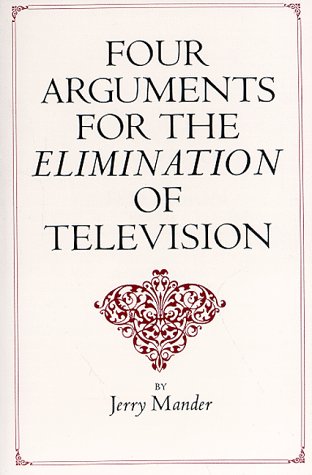
Four Arguments for the Elimination of Television by Jerry Mander (his real name!) is the landmark theoretical work of the anti-TV movement. As I whittle down my bookshelf, this is a title that I haven’t been able to part with yet. Instead of telling you just how much television I watched growing up, let’s just say this book blew my mind with its revolutionary anti-TV thinking.
The four arguments, each of which comprise a section of the book, are 1) The Mediation of Experience, 2) The Colonization of Experience, 3) Effects of Television on the Human Being, and 4) The Inherent Biases of Television. Sounds a bit wordy. The book is rather academic, but Mander goes places that others don’t. Awesome places.
One of the more abstract concepts he discusses, which took my brain a while to comprehend, revolves around what’s physically happening when someone watches television, from the type and patterns of light entering the eyes to the fact television viewers are being socialized to be passive participants in the world. Much of what he discusses has nothing to do with content–it doesn’t matter if you’re watching a game show or a documentary–another reason his book is an important read.
After discovering this book in 1998, I undertook my first TV fast, where I didn’t watch any television for a week. It went well–I seemed to gain a lot of time in the day, and even got to cross a couple other books off of my to-do list.
In the years since, I’ve done the TV fast several times, often as long as a month at a time. (I didn’t discover TV Turnoff Week until later.) One time in September 2003, I kept a log during the experience. Here’s an excerpt:
It seems to me that how my relationship with television works…is that when I come home, I eat, and there’s not much else I can do when eating except watch television. Then, it just sucks me in for hours. I could turn it off, but then I might forget to turn it on again for that great documentary on in a half hour, etc. Ultimately the nights fly by, and all because it’s hard to do things while eating. Then again, eating while watching television isn’t very healthy…

That particular TV fast was spurred by having read The Plug-In Drug by Marie Winn. Focusing more on the effects of television and advertising on children and families, Winn discusses television’s impacts on child health and development. Television’s influence on kids’ creativity, the lack of physical exercise leading to obesity (the edition I read was published in 1977…the problem has only gotten worse!), kids becoming über-consumers early in life because of targeted advertising. Although I’m not a parent, it’s easy to recognize how my own childhood was influenced by watching television, and how it even impacts me today. As an adult, I was given food for thought about how television discourages connection with other human beings and the world around them.
These days the telly at my house is off way more than ever before.
Feel like you don’t have enough hours in the day? Feel kinda blasé and numb during your “free” time? I’d recommend exploring the relationship you have to your television. Read more–there’s a great list of books here, or check out Kill Your Television. Do an experiment–give up television for a week and see what happens. Clean your house. Go for a bike ride. Read to the kids.
It’s amazing how much more you can do when television isn’t sucking up so much of your time.
Filed under books, television


 bookish