Apparently I’m an idealist. Or a perfectionist. Or maybe they’re the same thing, applied differently.
What that means is that for a very long time, I’ve thought it important to do my part to work toward what I see as a better future. The very first book that inspired and led to a big impact in my daily habits was Upton Sinclair’s 1906 novel The Jungle. Here’s one of the many passages that spurred the United States to pass the Pure Food and Drug Act (among other legislation) not long after the book was released:
“The meat would be shoveled into carts, and the man who did the shoveling would not trouble to lift out a rat even when he saw one—there were things that went into the sausage in comparison with which a poisoned rat was a tidbit. There was no place for the men to wash their hands before they ate their dinner, and so they made a practice of washing them in the water that was to be ladled into the sausage. There were the butt-ends of smoked meat, and the scraps of corned beef, and all the odds and ends of the waste of the plants, that would be dumped into old barrels in the cellar and left there. Under the system of rigid economy which the packers enforced, there were some jobs that it only paid to do once in a long time, and among these was the cleaning out of the waste barrels. Every spring they did it; and in the barrels would be dirt and rust and old nails and stale water—and cartload after cartload of it would be taken up and dumped into the hoppers with fresh meat, and sent out to the public’s breakfast.”
The book didn’t exactly make me vegetarian. But it did keep me there, with its descriptions of the havoc the meat packing industry was creating for the poor Rudkus family, recent immigrants from Lithuania just trying to survive in a new country. Whether it was an anonymous worker falling in a vat and made into lard, or poor Marija, cutting her hand and almost losing it from infection, the novel was fantastic and tawdry. It was only coincidence that I decided to read this book shortly after deciding to try vegetarianism, but it cemented in my mind that I had absolutely done the right thing.
Another book that was instrumental as an agent of social change was Harriet Beecher Stowe’s 1852 novel Uncle Tom’s Cabin, which I just finished writing a big paper about. At the time Stowe was writing the story, she lived in Cincinnati—right across the Ohio River from Kentucky, a major slave state. Escaped slaves using the Underground Railroad were the source of much drama in Cincinnati. When the Fugitive Slave Act was passed in 1850, making it a crime for anyone to assist an escaped slave, Stowe officially solidified her alliance with the abolitionist movement.
She decided to combine the political arguments of the abolitionists with dramatic and sentimental fiction. Stowe depicted her African American characters as having distinct voices and feelings, rousing empathy in the reader that they may not have had before, and influencing their stance on slavery. Uncle Tom’s Cabin had an immense impact in the US and around the world. Legend suggests that the book was the single cause of the US Civil War—although that makes a good story, it’s perhaps a bit simplistic.
The point is though, that stories about sympathetic fictional characters set against a socio-political backdrop is a really effective method of changing people’s minds about the world around them.
Do you have any favorite novels of social change? What books could you envision having this sort of success in changing the world today?
And it’s no wonder–Sedaris is deliberate about reading his work, taking detailed notes of audience reactions to consistently improve both his writing and delivery. His distinctive voice reminds many of Truman Capote, whose short story “A Christmas Memory” is often performed at theaters paired with “The Santaland Diaries.”
Here are my top five favorite David Sedaris stories. But you don’t have to take my word for it! Click on the story title to listen to David reading each piece himself!
At heart, this is a story about culture shock. A class full of international students learning French tries to discuss their different experiences of the same holiday, using limited skills in their new language.
“The drama bug strikes hardest with Jews, homosexuals and plump women who wear their hair in bangs.” As a high school theater nerd and Shakespeare-phile, this story makes me blush. Sedaris gets the details spot on, and I never get tired of listening to this piece. In fact, I even make an appearance in this story as David’s friend Lois.
2. “Poems About Dogs“ (Appeared in Esquire) [Unfortunately, I can’t find a spot online to listen to David reading this one. If you ever come over to my house though, I have it on CD and I’ll play it for you!]
Sedaris has written a series of jovial poems to share the less glamorous parts of dog ownership with the rest of the world. Or maybe he just hates dogs. Either way, it’s hilaaaarious.
David’s brother Paul is the star of this story, although Amy makes a cameo as well. Rather than describe it, you just need to experience it with David imitating his brother. Paul operates a website, and Amy’s book I Like You: Hospitality Under the Influence includes a recipe for the Fuck-It Bucket.
BONUS TRACK! Billie Holiday David is fairly well known for his impersonation of Billie Holiday. This is a segment from another great story, “Giant Dreams, Midget Abilities” (Me Talk Pretty One Day). You will never hear the Oscar Meyer jingle the same way again.
Bookish has been rather quiet the last couple of months, and might continue to be quiet moving forward. That’s because I’m preparing for some pretty big changes in my personal life, including moving to a different country(!) and starting a master’s program.
This has been a long time in the making–I was originally going to apply to the program at the end of 2007. It was at this time total lunacy started breaking out at my former employer, and if it wasn’t directly related to my job it pretty much didn’t happen–and even if it was related to my job (like keeping mentally healthy or getting enough sleep) often it still didn’t happen. Good times.
Anyway. Between the prerequisite books I’m to read before stepping foot inside the classroom in September, boning up my Adobe skillz as required, and trying to prepare for life in a new land, it is time for Summer School at Bookish HQ. (Sadly, not the kind that includes trips to Venice Beach and a German shepherd wearing sunglasses.)
Here are the books I am currently reading, or will be reading in the next two months:
• Adobe InDesign CS4: REVEALED (It’s maaaagic!) Last week I started an InDesign course at PCC, and we’re using this as a textbook. Interesting class. My mom and I thought we were choosing a traditional class over an online course, but our class is very non-traditional. Three classes–Intro to Word, Intro to Excel, and InDesign, are all being taught simultaneously. The textbook, in tandem with a PCC course packet, guide you through the work, and the instructor is there for support and grading. Our class time–three hours on Wednesday night and six excruciating hours on Saturday–is mostly just computer lab time. Attendance is not necessary as long as you’re getting your work done and are keeping in touch with the instructor so he knows you haven’t died. As my mom and I are sharing class materials and I was very sleep-deprived last Saturday, I spent a good portion of our class time napping on the bench outside our classroom.
• Help For Your Shy Dog Author Deborah Wood used to write the weekly pets column for The Oregonian. Her book seems to feature mostly moral support, rather than specific practical tips, for owners of fearful dogs. While I have not yet finished the book, my faith in working with Atticus on his fear has been renewed. I also recently discovered that Rescue Remedy is actually noticeably effective, which has definitely helped Atticus during fireworks season.
Unfortunately, Wood does not cover fear aggression very much, which is Atticus’ issue when he’s around other dogs. We still even have to keep him separated from Rain, the new puppy. He’s very slowly getting over his fear of her, but he will still growl if she gets too close to him. And because she’s a rambunctious 11 9 week old puppy who doesn’t understand warning growls, she will always get too close. They remain separated for now.
• Lonely Planet Canada About two months ago I got an email that began, “Dear International Student.” I chuckled. Yes, technically I am an international student, but not really, right?
Then a few weeks ago I was trying to wade through the Citizenship and Immigration Canada website to determine whether or not I needed to apply for a visa as a US citizen. The language was different than the legalese I was used to, and their 1-800 hotline didn’t work outside of Canada. It started hitting me: while I could be standing in the middle of Canada and not feel terribly out of my element, it turns out that yes, Canada is a different country with different laws and more confusing legalese that I don’t have a year to figure out all by myself. Now I assume that the International Student Office is going to be one of my best allies during the next two years.
Now that I have a new perspective, I need to study up. Lonely Planet guides have a great reputation for travelers trying to immerse themselves someplace else. The edition I have is not the latest, but I’ve had it for five years and it’s a good start that I don’t have to pay $26.99 to read. At some point I may also get Lonely Planet Vancouver and use them both for reference.
• Editing Canadian English Humble Canadians to the core, the authors have chosen to write a book of suggestions rather than edicts. As Canadian English is usually a mid-point between British and American English, there is a lot of disagreement even between Canadian dictionaries on spellings, uses of hyphens on compounded words, etc. Although I love style guides and this is a prerequisite book, it stirs up my fears about looking stupid by unknowingly messing up some Canadian English. Fortunately, I can switch my Mac’s default dictionary to the Canadian one–I hope this will help avoid embarrassing situations.
A favorite quote so far: “Henry Fowler declared that American and British English should not be mixed, an injunction that must leave Canadians speechless.” –Peter Sypnowich
• A Confederacy of Dunces “Like a bitch in heat, I seem to attract a coterie of policemen and sanitation officials. “
Right now I have six boxes of books behind me, waiting to be sold back to Powell’s. The more books I get rid of, the harder it is to weed more out. My beloved set of David Sedaris books is going–serious sacrifices are now being made in my earnest effort to lighten the load.
A Confederacy of Dunces is only the second book to be fished out of the box. While I can easily get it from one of the great libraries I’ll have access to, there’s something to be said for being able to pull it out at any time for a comedy break.
• Publishing for Profit If I’m to become a media magnate in just two short years (please note: this is not my goal), I need to know big business. What would Rupert Murdoch do? Already I’ve observed how PCC, with my InDesign class, is adopting a corporate model by minimizing expenditures and maximizing profit. But how can I be the front-runner in all things profitable when I believe that minimizing expenditures also leads to poor work quality–something I abhor?
While I do not wish to become more evil, I do hope to learn some successful business tactics reading this book. As a non-profit veteran, I definitely need to be schooled on capitalism. Right now, I’m not buying it. (Literally–ha!)
• Book Publishing I Published by the Canadian Centre for Studies in Publishing at Simon Fraser University. A book of articles by students of the MPub program about various aspects of publishing.
•Basic Marketing: A Global Managerial Approach A textbook about marketing. While I am excited to learn more about marketing, the 900 pages are putting me off a bit. While this is an older edition, I also suspect some new topics, such as marketing via social networking sites, will not be covered. Bummer.
• Essentials of Accounting (Workbook) If you know me well, you know that math-like subjects are not my forte. You may also know that when I am dreading something, I tend to put it off as long as possible. (Infer your own conclusions from the placement of this title.)
That’s the list. I’ve got two months to read five textbooks, get through my InDesign class, secure my student loans, find a place for Atticus and I to live in another country that doesn’t seem to have a lot of dog-friendly housing, and then pack up all my stuff and move there.
Now if you’ll excuse me, I think I need to go take some valium…
The photo request was extremely specific: they wanted a brown pelican, in breeding plumage, diving.
I had just received the latest round of comments back from a project in California. The clients, a small town on the California coast, wanted to pack as much wallop into this photo as possible.
“What? I don’t even know what that looks like!” I muttered to myself. Doing photo research is really difficult when you don’t know what it is you’re looking for. Googling the words gave me plenty of photos, but I had no idea what breeding plumage looked like. Certainly, none of them were diving.
Needing a moment away from my desk to think and commiserate, I stepped outside my office, exclaiming my quandary to my coworkers in the lobby.
A totally unexpected source chimed in, “Oh…I’m better with ducks, but I have a book I’ll bring in tomorrow. You can see what breeding plumage on a brown pelican looks like.”
And that is how I was introduced to The Sibley Guide to Birds.
Several weeks later I had obtained a discounted copy through Edward R. Hamilton booksellers, after which it became my most referenced book at work after the Chicago Manual of Style.
As many of the projects I work on involve basic bird identification, I’ve found Sibley’s guide to be invaluable. The book includes ample illustrations of adults (male and female) as well as juveniles. Species illustrations are done by Sibley himself, ensuring that you see the most important features of each bird. Range maps show where each species can be found in summer or winter.
After getting the book, I soon became a full-blown birdwatcher–the book’s organization helped me with that too. (See some photos here!) If I came across a bird that looked similar to a species I already knew, I could turn to the known species and start looking at the nearby entries. Once when I failed to write down the species in a photo, all I had to do was start looking at the terns for a mostly black and white species that would have Humboldt Bay, California, in its range.
The arctic tern–BAM!
Half of birdwatching is being able to identify calls, which is a slight weakness inherent of the printed medium of this book. Sibley describes calls, which is helpful if you’ve heard something and think you know what bird it is. The iPhone application iBirdExplorer is much better for learning call identification. (It also fits in your pocket better than the Sibley book does, too.)
At one point I owned the Sibley guide along with three other bird books. I’ve already retired two of those, and the third, National Geographic’sField Guide to the Birds of North America will be going soon. It has absolutely no wear, because I never use the darn thing.
Why would I, when I have the Sibley guide?
Note: David Sibley has recently released a field guide to trees! Sources say it’s just as good as the bird book.
Spring continues to offer some pretty chilly mornings in Portland, so I’ve been riding the bus more than I care to admit. One of the things I like to do when I ride the bus is read, which offers a perfect environment for the titles I’ve been delving into lately.
So without further ado, here are some great books to read on the bus (since you probably shouldn’t read on your bike):
This report may have been written in 1996, but it still holds up as a succinct summation of why urban planning that is solely dedicated to the car is completely unhealthy. What’s even better is that the content focuses exclusively on the northwest (including British Columbia), meaning I was painfully familiar with all examples cited. As I was reading the first couple of pages on the chapter about sprawl, I had an enormous urge to read it verbatim to the Clackamas County Commissioners, as the copy precisely describes the clusterfudge that my county currently finds itself in:
Sprawl requires longer and wider roads, more sewer pipes, more electric and water lines, more television cables, and more stormwater drains. Extending this infrastructure to each new dwelling on the edge of an existing neighborhood–assuming housing is built at urban densities of twelve units per acre–costs about $23,000. In suburban-style tracts with three houses an acre, the cost of infrastructure raises by half. In “exurban” developments–those tucked into the countryside beyond the suburbs–the cost doubles.
Sprawl necessitates more and bigger garages, and more public parking spaces, each built for upward of $1,000 plus whatever the land costs; in parking garages, construction costs are more likely $15,000 per space. Sprawl pushes fire, ambulance, and police services to their limits. It makes trash and recycling collection–and postal delivery–more expensive. It lowers the effectiveness of workers and businesses because it leads to traffic congestion: in the Seattle area, time and fuel lost to traffic jams is estimated to be worth $740 million a year.
Taxpayers pick up the tab for billions of dollars of these increased costs because governments subsidize both driving and sprawl with handouts, tax breaks, and uncompensated services. Sprawl is even a losing venture for local governments: a 1993 review of research literature showed that residential development on farmland is usually a drain on government revenue because the increased property taxes and development fees do not cover the extra costs of public services. Even shopping center development is often a revenue loser, counting the extra police and fire service required and the unplanned strip development that tends to follow.
Just finished this one yesterday morning, and I’m tempted to not give it back from the place I borrowed it.
• Atlas of Oregon
A treasure trove of cartographic proportions. Maps showing sprawl, historic native lands, watersheds, and more. Okay, this one might be a little too big to read on a crowded bus unless your neighbor doesn’t mind having the edge of a book in their personal space. Fascinating nonetheless!
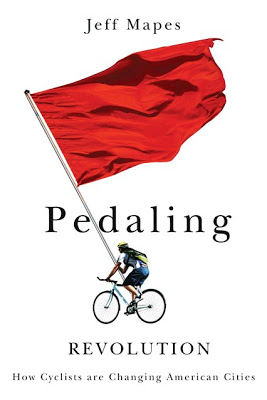
• Pedaling Revolution
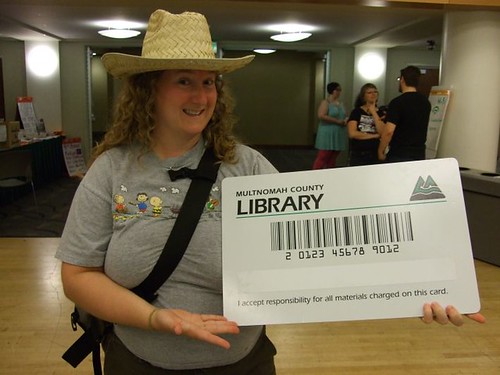
Just started reading this on my way in yesterday morning. Released by OSU Press and written by Oregonian reporter Jeff Mapes, the writing style is engaging. Generally I’m not a fan of journalism, with its priority on short deadlines, “the scoop” and sensationalism over being factual. However, when I opened this book to have a peek, I came across the beginning of a chapter detailing Multnomah County Bike Fair, the pinnacle of bike existence for many of the people I associate with. Since he was covering an event I’ve been to several times, I was hooked. Who doesn’t want to see how their peeps are represented in print?
• The Constant Rider
This started as a zine about Kate Lopresti’s adventures on Portland’s TriMet system, but there is now a Constant Rider Omnibus available from Microcosm Publishing! You’ll read about Kate’s story of fainting on the MAX one summer morning and getting an unusual memento from one of the responders; the guy who hit on her during not one, but two different bus trips; and watching a TriMet operator buy unmentionables at Meier and Frank…what a read!
Originally I discovered this zine in an exhibit at the IPRC, and was fascinated about the brilliant idea of someone publishing stories of crazy people she met on the bus. Later I read almost all of the existing issues by checking them out of the IPRC zine library.
• How to Live Well Without Owning a Car
Pure and simple, this is an awesome book. If you’ve ever dreamed of going carfree, this book provides a world of practical ideas for making it as easy as possible. The author has spent years of carfree time living in cities not known for their alternative transportation options, so I am doubly impressed by author Chris Balish. You will finish the book inspired and completely ready to take the plunge into carfreedom.
• Divorce Your Car!
This book was more in-depth about the systematic dismantling of the nation’s streetcar systems by auto manufacturers than I’ve come across before. If I forget about the mentions of my employer in the book, the coverage given to walking or biking kids to school, or any of the other cool topics contained between the covers, I will always remember this book as the one that gave me my first significant look at the Great American Streetcar Scandal. The damage of which, incidentally, we’re still trying to slowly erase, some 60 years later. Boo.
In addition to all these fine reads, I hope to soon read Car Sick: Solutions for our Car-Addicted Culture and Traffic: Why We Drive the Way We Do (and What It Says About Us) soon. I’d also like to eventually read the work of Donald Schoup and John Pucher. Schoup has done extensive studies about the real price of “free” parking, and John Pucher is a vivacious fellow who looks at the public health impact of land use policies, particularly regarding active transportation. (I had the chance to watch him give a presentation at PSU last year and although he said he had two hours of sleep, he was charming, lively, and interesting–a pleasure to watch!)
You thought that this blog perhaps should have been named “bikey” instead of “bookish,” right? Well let me tell you about my trip to the Vancouver Public Library today. It still makes me a little misty-eyed thinking about it.
Today I decided to try biking the seawall up to Stanley Park, and possibly a little additional exploration as well. I asked my hosts about if there was a nearby library branch I could check out, and they suggested I just head to the main branch–”it looks like a giant coliseum.” After navigating the sunny day congestion along the seawall and trying to make my way toward the library, I was stopped at a light, casually looking around, and I gasped in realization. It was right in front of me, and it really does look like a giant coliseum!
Giant Coliseum-er, I Mean Vancouver Public Library
After locking up my bike I discovered a recessed fountain, and then a crevice-like path to follow to access the interior. Next, the atrium:
VPL Atrium
At this point you’re not inside the library, but the building offers a warm area with coffee shops and cafe seating, which both protects visitors from Pacific Northwest rain as well as taking full advantage when the sun makes a cameo appearance.
Once inside the library, I instantly found the information desk, thanks to some really clear signage (signage is really hard to do well!). The man I spoke with was very friendly and gave me just the right amount of introductory information, and didn’t seem too put out as I expressed my awe of the amazing building. A short conversation later, I had taken a couple of brochures, and was on my way up to the special collections room on the seventh floor.
Two display cases flanked the entrance of the special collections room: one displaying many antique-to-modern copies of L. Frank Baum’s Oz books, the other with many antique-to-vintage copies of Lewis Carroll’s Alice books.
Alice Speaks with the Cheshire Cat
In addition to the library’s collection of antique children’s books, they boast a photographic archive of first nations and Vancouver history. I took away several pamphlets to use as reference in my future photograph research.
As I explored the room, I eventually came to the window that overlooked that gigantic atrium. While looking over and seeing so many using the reading desks on floors below gave a sense of humanity to what is often seen as a cold and anti-social place, having an entire wall made of glass meant it was rather dizzying to look all the way to the ground.
Eeek!
Doesn’t it figure that the Canadians would build the best and coolest public library building ever? Once again, they totally win out in terms of funding for important community centers, not to mention arts and humanities. But there’s hope! My hosts mentioned that Salt Lake City copied this building for their own library a couple of years ago. Let’s hope other US cities don’t just continue to copy this building, but will soon start uniting form and function for the good of the people. This building proves that it can be done.








 bookish