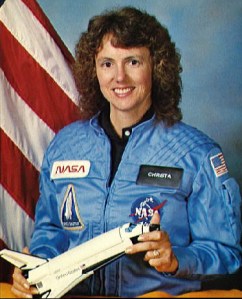
When I was in second grade, my career goal was to be an astronaut. One of my favorite movies was Space Camp. My library consisted of large books about the solar system. With the help of H.A. Rey, I knew most of my constellations. My dad and I built a model space shuttle which hung from my ceiling. I had Astronaut Barbie!
Even seeing a nice lady teacher get blown to smithereens a few weeks after my eighth birthday wasn’t enough to dissuade me.
But you know what was?
The following year, OMSI installed a one-room astronaut exhibit at their old location, centered around their acquisition of a modified aerotrim. Exhibit panels outlined the education and training one needed to go through to become an astronaut.
Under physical requirements, it said women needed to be a minimum height of 5’4” to be accepted into the space program. With a grandmother that was 5’2” and a mother that was 5’3”, seeing that number is all it took. I told myself that it was possible I could grow to be taller than either of them, but I didn’t really believe it. My dream died that day.
Suddenly it wasn’t as important for me to continue struggling through learning my multiplication tables. When I came up against a challenge in science, I was much more likely to be okay with rolling over and playing dead. When I visited OMSI the next time, seeing the same panel gave me the same strong sinking feeling in my stomach, but I bucked up and moved on to watch the dissection of a cow eyeball.
A local woman is currently studying a journalism textbook, despite a lifelong hatred of the genre.
Heather Andrews, a resident of SE Portland, is reluctantly reading Inside Reporting by Tim Harrower. Aimed at journalism students, the text explains the basics of the field by a veteran of The Oregonian.
“In college I learned a lot about academic writing,” Andrews pointed out. “In the nine years since I graduated, I’ve noticed my writing doesn’t seem effective with non-academic audiences.”
When Marie Naughton, an area writer, noticed differences of readability and audience interest in Andrews’ writing, she staged a small intervention. Naughton loaned Andrews the textbook, which she had contributed on, along with a gentle suggestion that Andrews diversify her writing skills for greater success.
Andrews confesses a longtime hatred of journalism, fueled by cable networks and her own experiences with the press. She decided to read the textbook hoping that her views would be changed.
The book, Naughton explained, uses a user-friendly method of teaching basic ideas of journalism. Each page is designed like a newspaper or magazine, tackling several ideas in each two-page spread. Along the bottom margin, users are pointed elsewhere for in-depth information on a specific topic or for samples of work.
When asked whether or not Andrews plans to also give up her “Midwestern Bible,” the Chicago Manual of Style, for the Associated Press Stylebook, she retorted “now that’s just crazy talk!” with a glimmer in her eye.
Anything in your life that suffocates you is junk. Anything that crowds the life out of you is junk. That which restricts our living, loving, thinking, and feeling is junk, be it a thing, habit, person, place, or position. Anything that builds, edifies, enriches our spirit–that makes us truly happy, regardless of how worthless it may be in cash terms–ain’t junk. ( Not for Packrats Only, p. 142)
These days when friends ask me what I’ve been up to, I usually start beating around the bush, telling them about working on my bike or the poop cupcakes I made last week. Eventually though, I must explain that the bulk of my mental energy the last few weeks has been dedicated to decluttering my house, and why it has been so important.
A year ago, I felt like my life was out of control. My house only reflected that chaos. Instead of being a sea of calm in a cruel, cruel world, any notion of respite at home was laughable at best. There was so much “stuff” catching the dust my rickety old house generated, I couldn’t really keep anything clean with the little time I had. After about six straight months of intense drama in the outside world, I decided to make my home a pleasant place to be for me. This spring I started reading books like Clutter Control and various web sites like Unclutterer, and made some slow, steady progress thinning out my immense book collection. Then this summer I started watching Hoarders.
If you haven’t seen it, each episode of Hoarders (which you can view online!) features two compulsive hoarders whose living spaces are so packed with stuff that they face eviction, jail time, losing their children, or more. During the episode, they try to clear their house aided by a mental health and/or organization professional who specializes in working with compulsive hoarders. There is an amazing age/gender diversity among the hoarders, and many of them function so well outside the home that they regard their house as their one huge, shameful secret.
When the hoarders clean their house with the professional, a series of questions are asked about specific possessions. A high level of anxiety usually subsides, uncovering other emotional issues, which are then discussed and worked through one possession at a time. Although all the hoarders make some modicum of progress, it’s clearly a struggle, often exacerbated by external hardships like living with an alcoholic parent, a family’s impatience with the hoarder’s behavior, meeting an external deadline to avoid eviction, and so on.
Inspired by this show, I started noticing hoarding-like symptoms in myself and those around me. An entire closet shelf of different versions of my favorite game, even though the friends who come over don’t really enjoy playing it. Having difficulty finding seating in the room a relative spends most of their time in, because the room is packed to the brim with fabric and magazines which they claim will be used “someday.” Keeping an unplayable, unfixable violin for ten years because of my sentimental attachment to it.
My mind on overdrive, a few nights I woke up at 2am and started obsessively reading books about decluttering and the psychology of clutter on my new best friend, Google Books. Cut the Clutter and Stow the Stuff was instantly intriguing to me, as it seemed more in-depth than your average anti-clutter book, separating out different types of clutter personalities and pointing out specific pitfalls. Stop Clutter from Stealing Your Life was written by a former hoarder, presenting a compelling true story and digging into clutter/hoarding psychology a fair amount. Reading the Google previews of those books inspired me to start taking more drastic action with the stuff in my house.
And then I discovered Julie Morgenstern.
A friend forwarded me a link to a book she wrote about making your work life work for you, called Never Check Email in the Morning. (Oh, if only I had had that book a year ago!) I liked the Google Books preview so much, I requested the book from the library. At the same time, I watched the short video Amazon had posted to promote another one of her books, SHED Your Stuff, Change Your Life. In that video, she discussed her past life in theater, and when she finally got rid of her old scripts, her new organizing business suddenly billowed.
“Hey, I was just contemplating getting rid of all my old scripts the other day!” I reminded myself. It was like she was speaking directly to me, and I was hooked. Purging continued steadily as I sold my old piano/violin/vocal music on Craigslist, cleared out more books, trusted the universe to provide me with the clothes I needed if I would just throw out my nasty old T-shirts, and finally recycled some scripts.
At a thrift store last week, I found and started reading Not for Packrats Only while I waited for a friend. Perhaps I should point out here that I am refusing to buy any of these anti-clutter books, on the principle of stopping clutter before it starts. Instead of buying this book for $1.99, I checked it out of the library and have since been alternatively inspired and dismayed by the literary equivalent of a fluffernutter.
Regardless, I continue plugging along on my purging mission, asking myself a series of questions I’ve learned from the collected wisdom of these books. When was the last time I used this? Why do I still have it? Is it something that I feel I need to keep for my identity? What can I do or tell myself to allow me to let it go anyway? Is it worth the space it takes up? If I keep it in storage is it going to get worn or destroyed? Can I get another one when the “someday” I am saving it for comes? Would the money it could bring in do better in the bank than what the item is physically doing for me now? What’s the worst that could happen if I get rid of it?
Already I’m experiencing the impact of letting go of the old to allow in the new. Much like Julie Morgenstern experienced, an excellent, unexpected opportunity appeared on the horizon yesterday, supporting the direction I want my career to be moving in. I’ve gotten the shot in the arm to keep trudging along in my quest for a happy house.
Moving forward, I will strive to be more conscientious about the things I let in past the door. The past few years I’ve tried to help my relatives by giving them genuinely useful Christmas presents instead of more “stuff.” Some items I’ve come across I’m planning to use as gifts, creating a win-win situation–they get a useful present, and I get to get rid of my “stuff!”
Extrapolating from physical clutter, I’ve even started setting my sights on a philosophy much like the one at the top of this post, trying to keep mindful of people, ideas, situations, or whatever causes as much mental clutter as that milk crate of sheet music I just sold.
Thus, if I know you, you had better start “enriching my spirit” or I’m dumping you off at Value Village along with my old sheets!
Facebook has reunited me with many people from my past, including several from high school I hadn’t been in touch with since the evening of my graduation or earlier. Some of them have remained friends since that time, some of them were friends until we lost touch, and some were never more than mere acquaintances. Of these acquaintances, I’m vaguely curious about hearing where those people are in the world, but that’s about all.
As I acquired these Facebook friends, my friends update page started filling with profile photos of women’s large bellies, hundreds of snapshots from various toddler birthdays, idyllic (and completely unbelievable) family portraits of my acquaintances and their new families in matching sweaters, status updates about breastfeeding, results posted for the quiz “How many babies will you have?,” and more.
At one point, I updated my status to “Heather is amused at family portraits with matching sweaters” or something similar. And sadly, one of these acquaintances, who must have thought I was talking about her specifically, chose not to be my friend anymore!
Really though, I’ve never been much of a kid person. When I “catch up” with many of these same high school people, they often (especially if they’re female) ask if I’m married and/or have any children. Which probably proves we were never really friends, or they were never really paying attention. Of course offering back a simple “no” without editorial comment is a lot easier than delving into why I don’t really love children (except yours, of COURSE!), or my support for the Voluntary Human Extinction Movement. Or daring to say that I have never wanted to sacrifice my career or happiness for children. Or all the other things I could say that would be even more honest.
Instead of the brutal and unpopular truth, I’ve tried to become more accustomed to being around my friends’ offspring, remaining mostly open to new kid experiences. Some of these kids are great–I can sit and converse with them without wanting to tear out my hair. Other kids, not so much.
This adjustment has been mostly out of necessity, because it seems that almost all my peers are having children. I’m continually befuddled why they are doing this, but in the meantime, it helps make me slightly more socially acceptable.
Just over ten years ago, during my longest stint to-date in New York City, I bought a blank book at my neighborhood Barnes and Noble. Made from recycled maps, it was just what I needed to start writing daily. Being in New York was stressful, I had nowhere to let off steam, and the book was as cheap as it was lovely–very important for an aesthetically-conscious student!
Thus began a year or so of writing down my day-to-day thoughts.
Recently I skimmed through the original nameless book and those that followed, reminiscing about the past eleven years, marveling about how much things have changed, realizing how much they’ve stayed the same, and gaining some insight about the early days of what are now some of my most deeply ingrained habits.
The majority of the first book was written during my time in New York. The writing has an innocent, optimistic feel to it despite much of the content surrounding struggles with roommate dynamics and missing home. At the beginning, I make myself a promise: I hereby resolve that I will not write in here every day. It wouldn’t last until the end of the two months I have left here, and I’m not very good about forcing myself to write regularly like this–it’s one of those extra things I do when there’s no other pressing issue–school, for example…. This first volume contains mementos from New York, such as several leaves collected on my many walks through Central Park. As the leaves became dried and flat between the pages of the book, so did the once-vibrant colors. Other mementos include comic strips I cut out of Willamette Week when it was sent from home–strips that don’t run in Portland anymore like “This Modern World” by Tom Tomorrow (Bill Clinton: “I let an intern play with my wee-wee!”) or “The City” by Derf.
The writing contains mementos too, like quoted lines from shows I saw in New York, like the clever drag play The Mystery of Irma Vep (“Virginity is like the balloon in the carnival of life…it’s gone with the first prick.”), and references to my internship at the non-profit wing of a well-known media company. An early art critique: (“The more I see abstract art, the more I want to inflict violence upon abstract artists–but this abstract sculpture garden was different.”) Finally, a warning based on personal experience one long Sunday afternoon: “Note to self: never try to cross Central Park during the NYC Marathon.”
A Tibetan painting of Buddha and a mandala is on the cover of the next book, which I bought at a Met exhibit while still in New York and started using a few weeks after my return. During this time, I received my first negative work review: Already I was kinda crabby today, then I got an email from H. (from [my internship]) which contained a copy of the evaluation letter she had already faxed to my school. At first, I was totally flabbergasted, so shocked that I was numb. Then, I felt like crying. And angry. Now, I just need to have a talk to [my professor] about the fact that there are two sides to that letter. Either way, it just brought me back to reality about my internship, and really about New York. I was uncomfortable there. Some crazy part of me thought I mildly enjoyed my internship, and New York wasn’t so bad–in the past week. Duh me! Occasionally it crosses my mind whether this bad evaluation letter may have been retaliation for the internship review I turned in before leaving, or the result of my wacky west coast, Birkenstock-wearing self just not meshing well in an east coast corporate culture. Regardless, it still hurts to think about this letter. I think it paved the way for my total dread surrounding written reviews, and my wondering whether people secretly hate me became even more pervasive.
A group of ladybugs grace the cover of the third book. It still has blank pages in it, gaps of several years between entries, and features my early efforts at becoming a bike commuter: Next weekend I think I’m going to bike to school, to see how it’s done. Maybe if it stays warm in September I’ll be able to make the trip a few times. I know I can do it, it’s just a matter of doing it. Well, ‘cept I imagine I’ll be walking most of [Riverside] cemetery–the BIG HILL… Turns out that the bike I was using at the time was pretty great for a newbie to go up the big hill, although that hill wears me out to this day. Occasionally commuting to school like that was just the beginning of what has become a beautiful adult relationship with the bicycle. This book also documents the day I moved into my house (this Sunday is a milestone anniversary!), my first experiences as a research assistant for a textbook, a swatch of fabric from my Into the Woods costume, references to my “allergies” that ended up actually being a toxic mold in our theater building, and much, much more.
That last book isn’t full though, even though it was started in July 1999. The regular entries end with September 5, 2001, and then are sporadic: one entry each in 2002, 2003, and 2007. During times of inner turmoil through the years I realized that I should restart my habit, but other things usually got in the way. Writing things down, making lists, creating on-the-fly haikus, and collecting extremely flat mementos are both helpful in the moment and looking back. It is with this in mind that I have started filling up the rest of that book–an attempt to get back in the habit of documenting and working out inner struggles, and providing insight for my older self. And possibly my future biographer. : )
Have you ever looked back at your old writing and uncovered new insights?
I’ve been very excited about the green line since I stumbled onto the project web site in an early phase, around late 2005. My very own neighborhood getting a MAX line! If you have talked to me at all in the past couple of years, you probably know how excited I am about it.
During that time, I’ve eagerly watched the slow progress of the project whenever I traveled the mile east of my house to I-205, as well as at my (former) office located along the line in NW Portland. During my last two months on the job, I got daily reminders of progress: encountering groups of operators being trained; hearing the gentle, old-timey “clang clang” of bells on the new trains (above); and watching the installation of brushed aluminum bus shelters, bike racks, and garbage cans in the street next to my workplace.
Yesterday’s preview ride started on NW 5th, a block away from my former office. It was the last preview ride being given before the line opens September 12. The two rail cars were packed like sardines, mostly with staff members of the Portland Development Commission and Columbia River Crossing, along with others with random connections to the project, such as me.
The noise level in the train was excruciating during the first leg of the tour, the bus mall in downtown Portland along 5th and 6th Avenues. Not only were most of the sardines trying to have loud conversations instead of enjoying their preview ride, but TriMet staff were using an overly-loud intercom to point out interesting development projects along the line. It seemed the intercom was experiencing major interference of the buzzing sort whenever the train was in motion–possibly related to the electricity conducted in movement along the overhead wire. A elderly man representing Ride Connection was trying to make conversation with me, but between all the ambient noise, a miserable cold making my ears stuffy and my voice low and soft, and possibly his elderly hearing loss, we were not very successful.
Eventually we made our way by Union Station on a new segment of track, and started east. Since I have taken the MAX from NE 60th to Chinatown fairly regularly, this segment was mostly old news. However, I did take the time to notice the larger windows on the new trains, shiny aluminum edging on the new seats, and the friendlier partition between MAX operator and passengers (plexiglass with an openable window vs. solid wall/door on the old trains, making it possible for passengers to actually see ahead of and behind the train!). It was also very fun to go by existing MAX stations, like Hollywood, and move past a whole platform of people with completely befuddled looks on their faces (“Why isn’t this train stopping? It says ‘Not in Service’ but it’s full of people!”).
Once we got to Gateway, the real preview started. This is where the green line turns south to the new rail segment, eventually terminating at Clackamas Town Center. I’ll admit it wasn’t a particularly scenic tour, particularly if you drive I-205 with any regularity. There was a lot of freeway, beds of rock, grassy highway waysides, and freeway noise partitions. The real draw was being able to finally get a close-up view of each station.
Platforms along the route are fairly simple, with roofs evocative of old-time train stations, built in a more modern aluminum. One of my favorite features is the beautiful iridescent tiles surrounding the post of each of these structures (above)–tiles at each station are a different color. I imagine this color coding could be a very effective way to quickly tell which stop you’re at, if you’re visually impaired and not able to see great distances, or missed reading signage as you passed it. It’s also reminiscent of the beautiful tilework of the New York City subway system.
In addition, each station has a unique piece of public art that was created specifically with that neighborhood in mind. There are a lot of problems with “token” public art like this: you generally have to design it to be vandal-resistant, it’s easily ignorable, and often ends up looking like a poor imitation of Isamu Noguchi’s work. There are definitely some pieces along the green line that miss the mark, like the blue, twisted up fence sculpture called “Sky to Earth” at the Division station, which screams to me “vandals attack construction site.” (If you think about it though, vandals attacking a construction site is very Outer SE Portland! And I am allowed to say that because I’ve lived here for 31 years.)
Fortunately there are a few installations that fare much better. Most notably “Shared Vision,” a kinetic sculpture featuring metal Chinese lanterns and a flame motif, with moving pieces that make gentle clinking sounds in the breeze. Apparently this sculpture has fiberoptic lighting to draw attention to itself at night. With such a large concentration of Portland’s Chinese community populating East Portland near this station at Holgate, it’s easy to identify its appropriateness for the neighborhood. It moves me almost as much as this piece from the yellow line’s expo center station, which I think is my favorite piece of public art of all time.
We were given the opportunity to get off the train at the Lents station, giving me better photo ops than those on the moving train. It was at this point I also noticed the tempered glass windbreaks under each shelter structure, featuring a marshy scene of reeds and sparrows. This stop also gave me the opportunity to notice the new elevated crossing built for the adjacent multi-use path as part of this project. (Crossing most of the highway-feeder streets on this path as a pedestrian or cyclist has always been dangerous at best, so eliminating even one of these is very helpful.) Here I also got a close-up look at one of the more engaging art pieces (above). Looking at the “Art on the MAX Green Line” brochure, I’m not sure if the piece is still unfinished or if the yellow and red flower tops shown in the brochure illustration were scrapped at some point, but this is another installation that will be lit at night using solar panels that live on the structure.
There are two problems that haven’t been solved for this new line. First, if you’re unfamiliar with the stops on a train, it can be very stressful to make sure you’re not missing your stop–a great way to help passengers avoid this stress is to post line maps above every door, at minimum, preferably with lighted dots that show the train’s progress. The last time I was in New York in 2004, it was a very welcome addition when I was riding lines my memory was a little fuzzy on, and I’m very surprised it’s still so difficult to get that basic information when you’re on a MAX train. Second, most of the stops have enormous, ugly parking lots that are difficult to avoid, but dangerous as a cyclist or pedestrian. Traversing through a parking lot is hazardous if you’re not in a car, and that’s the largest reason I’m choosing to use the tiny Flavel station over the larger, equidistant Fuller station–I can access the platform at Flavel from Flavel itself, rather than needing to traverse an area where people are rushing to park to make the next train, or not looking out for pedestrians and cyclists before they back out of a parking space. I know that TriMet has a better ped/bike awareness than most agencies, and strives to improve functionality and safety on their capital projects, so I hope these improvements will be made for the future Milwaukie light rail line.
After passing my future Flavel station, we climbed over the elevated structure at Johnson Creek Boulevard. It seemed natural to want to get a photo from the top of the structure I’ve watched slowly being erected over the last two years. Due to timing though, I only managed to get two off-center photos, one from the north side of the street, and one from the south side of the street. Living so close to Clackamas Town Center (the terminal station) my entire life, I appreciated a historical new perspective on the building, and took this shot of the mall (although in general I abhor the place and don’t think it’s much to look at).
At this point both my camera and iPhone had run out of space for photos, so during the ride back I mostly relaxed, watching my very own neighborhood roll by from a MAX train, and savoring my last month of anticipation before opening day.
See more photos from my tour here. And here is an interesting compilation of cultural history along the I-205 line.
Yesterday I created my first mock-up of a zine (cover shown at left), partially to start utilizing the InDesign classes I took at the IPRC this winter, and partially to build my portfolio up a bit for future endeavors.
Here’s where you come in, friend. I’ve come up with a few topics, but can’t decide which I should tackle as my first project. What would you prefer to read?
• Walking tour of Chinatown, for a friend’s newsstand currently in development.
• In the Kitchen, a zine of thoughts about food and cooking, recipes, photos, etc.
• WWII Japanese internment camps. A lesser-known topic, but important. I have some good photos of the three I’ve visited, and there are plenty of public domain images available that Ansel Adams took for the United States government.
• Bikes! Bikes are well-covered in the zine world and in Portland, so it would probably need to be more specific. Like doing bike moves, how to choose a bike, stories of people’s individual bikes, or something like that.
Leave a comment below with your vote and thoughts. Next week I will take a look at the responses, and start moving forward with my planned production schedule. Thanks, friend!
Until a couple of years ago, my hair seemed problematic to everyone.
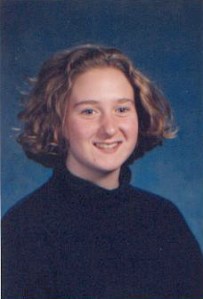
Photographs show that the early years went relatively well. As a cherub-faced toddler, flaxen ringlets cascaded gently down the sides of my head. A little frizzy perhaps, but there was a general consensus by all that I had curly hair.
(Perhaps I should also mention that the parent who passed the curly gene on to me was not on the scene after I was three years old. An important factor moving forward!)
By kindergarten, my hair had grown to waist length. My straight-haired mother would braid it each night before I went to bed so it wouldn’t get horrifically tangled (the worst tangles were always at the nape of the neck). After a bath, she would apply some leave-in conditioner, comb it out, braid it, and when it had finally dried, I chalked any curliness up to the braids. If that wasn’t enough trouble, at school, the metal rivets on the backs of the chairs would pull my hair out, a few strands at a time, nearly every time I got out of my chair or turned my head. Pretty painful for a five year old!
When I was in second grade, I decided to cut the length off. That’d solve everything, right? My mother told me that I would still want bangs, and since my mother knows everything(!), I trusted her judgement. My hair seemed to mostly act straight, and any memory I had of having ever had curly hair faded away.
Soon though, I started getting small pieces (especially the edges of the bangs!) that would randomly stick up like a wing on the side of my head. The only relief was during the few minutes it would stay tucked behind my ear. It wasn’t long before another wing sprouted on the other side. I kept careful watch over my head to make sure it didn’t fly off to Baltimore without me.
Throughout the rest of elementary school, I tried other control tactics, like a perm(!) in fourth grade, and in sixth grade, I just started pulling up the canopy of my hair into a barrette, teasing and hairspraying my bangs into reaching for the stars in submission. It just never really looked all that great, but I was perpetually befuddled about what to do.
Diverging from my mother’s input, in seventh grade, I took creative control and made my bangs part of my hair again. I even stopped brushing my hair for a period. My locker mate teased me about this, but the fact was that it looked better than it almost ever had. In eighth grade I cut my hair into a bob, the style it mostly remained in for the next ten years.
Whenever I would get my hair cut, people would say my hair had “the perfect amount of curl,” whatever that meant. Depending on the circumstances it might be a little wavy in the morning, but it would usually go limp rather quickly. On rainy days my hair would sometimes even look a teeny bit curly.
There were a couple of times I used foam curlers for high school theater productions, and was very surprised how great it always turned out, and how long it stayed in place. Friends always complained that their hair never held the curl long, if at all. I usually shrugged, not knowing how to explain my luck.
After having success with another lifestyle experiment, late in 2006 I decided to see what would happen if I started trying to encourage the curl instead of being apathetic about it. Internet research quickly led me to the book Curly Girl by Lorraine Massey with Deborah Chiel.
According to the book, some pretty radical changes would be necessary if I wanted to see how curly my hair truly was. No normal blow-drying. No brushing. And this is the one that always surprises people–no more shampoo.
That’s right kids, I haven’t shampooed my hair since February 2, 2007. And it has never looked better.
This process quickly revealed a head full of beautiful Botticelli ringlets like the ones in my baby photos, so it only took a couple of months for me to reclassify this project from an experiment to a full-fledged lifestyle change. Shortly thereafter I also discovered NaturallyCurly.com, where I learned even more: plopping, a more detailed hair-typing system, new products to try, and more.
For many years, I wasn’t able to grow my hair past shoulder length, as it would start looking wretched and be completely unmanageable. I would get a haircut about every 3-4 months. Now I can easily go a year between haircuts. My hair reaches far beneath my shoulders and if the attention it gets from friends is any indication, it’s looking better than it ever has!
If you tend to wear your hair in a ponytail all the time, or if you get major frizz when it’s rainy or humid, you might have wavy or curly hair that you’re not caring of properly. Do yourself a favor and read Curly Girl–you can even preview some of the content here. (The book covers kinky hair too!)
After years of following the same old thing unquestioningly, I reaped big rewards trying something radically different. Discovering how to properly care for my hair was thrilling, and such a successful experiment will serve as inspiration for future experiments I undertake.
There’s nothing better than enjoying an Oregon summer by hiking up to a waterfall in the gorge with my doggy. Watching scenic farm views biking through rural Washington County just before harvest. Sledding on Mt. Hood in the winter. Paddling the Tualatin River in spring.
And then going home to sleep in my own bed.
But there are many people on this earth that would take issue with me regarding that last sentence. There’s this thing called “camping” where you go enjoy nature and then sleep out there–either in a tent, or for some, in a behemoth motor vehicle that costs as much and acts as a second home.
There are people who not only look forward to this “camping,” but actively try to camp as much as possible. They buy titanium cookware and don’t even use a sleeping bag, they’re so hardcore. They bring a shovel to dig their own toilets. They wear pelts and howl at the moon. They get people to come camping with them year-round by forming teeny non-profits dedicated to get people to sleep in the wilderness.
Then there’s me. Although I’m very familiar with this “camping,” and have done it a fair amount since I was a wee lass, it’s something I generally don’t seek out or look forward to. Perhaps I’m just spoiled by living in a city where a natural area is within walking distance of almost anywhere, but camping isn’t very appealing to me. What’s the big deal, you ask? • Doing Without: I can live on simple food for days, but not without access to running water, including the opportunity to shower daily. (If I can’t wash up, nasty things start to happen…) Also, not a huge fan of being in places for extended periods without access to the intertubes–because you never know when you’re going to need access to that YouTube video of the Mojito Dance! • Effort: Why on earth would you choose to buy a bunch of expensive gear, which just takes up space in your house most of the time, take hours to pack, schlep your junk all the way out to some distant location, then go through the rigmarole of setting it up for use, only to break it down first thing the next morning, then lather, rinse, repeat depending on the length of your trip? • No Escape: Camping is most often a social activity. This is a problem if you require a lot of alone time each day. Thin tent walls won’t usually keep out the noise of the chatterboxes. And if you lose your patience with someone, too bad! You’re stuck there.
After months of gentle nudges from many cohorts, and hearing that there was to be a trip to Stub Stewart State Park, I decided to get it together and try out this bike camping thing. Stub Stewart is Oregon’s newest state park, located about halfway between Banks and Vernonia on the Banks-Vernonia non-motorized transportation corridor. State parks have showers, spigots aplenty, and this state park is within cell phone range, meaning I could turn my precious iPhone on periodically (conserving the battery!) if I needed to chat with God in a pinch. I’ve heard good things about it from many who have been there since it opened two summers ago.
Saturday morning I set out at 8am, and took TriMet’s 71 bus, then the MAX Blue Line from E 60th aaaallllll the way to Hillsboro on the other side of the metro area, where I arrived about 9:45am. I hadn’t been waiting long when the rest of the group showed up within a few minutes of each other. There were six of us all together, with another person who had gone up to the campsite a day early.
The first part of the journey took us from Hillsboro to Banks along flat, open rural roads with scenic farm views. Dense fields of wheat, U-Pick blueberry farms, nurseries, clover fields. My co-riders chose to ride on the very edge of the roads, and I rode significantly to the left of the edge, as these rural roads were usually skirted by steep descents into rocky irrigation ravines–meaning if I didn’t give myself enough room and lost control just a little bit (not uncommon for me!), I could find myself falling in a ditch. No thank you!
But of course, even though our route included very low-traffic rural roads, which now have huge signs on them showing a bicycle and saying “SHARE THE ROAD” since Tim O’Donnell’s death in 2007, our group experienced a big-ass pickup truck driver slowing down and suggesting to the people in the back of our group that “you people” should ride further to the side of the road. A road where their tires (but not mine, admittedly) were less than a foot from the end of the asphalt! Oy.
After a stop at a grocery store in Banks and a quick tour of a new subdivision, we began the part of the ride I was most looking forward to–exploring the Banks-Vernonia non-motorized transportation corridor. A converted rail line very similar to the Springwater Corridor that skirts my neighborhood, the trail began with a very gentle uphill grade as we biked through more wheat fields, now surrounded by wooded hills. Eventually the trail became completely shaded by trees, and the grade increased, but was still a very gentle and manageable climb. (Part of the reason old rail beds make such great bike/ped corridors is because of the gentle curves and hill climbs that were required for trains.) We rode over a gorgeous improved railroad bridge, and then as the afternoon temperature was starting to climb, we made our final hilly push up to the park in the shade.
Once at the park (and figuring out that we were at the park…if you’re approaching along the trail, it’s unclear whether the road you cross is the park road or not), we slowly pushed up a steep shorter hill to the visitor center, where we stopped to drink water in the afternoon sun before heading off to our campsite. I believed–falsely–that the most arduous part of the journey was over.
We were to be staying at the camp’s hike-in campsite, which included a journey along a thickly-graveled road, a quarter-mile long, that first went straight down where it crossed Brooke Creek, and then straight back up. Not willing to bike on such thick gravel at such a steep grade on my loaded road bike, I walked most of the way, grumbling, as my heavy bike still had difficulty remaining upright. It wasn’t long after we finally came to our campsite that I discovered the nearby toilets were vault toilets (at least they had hand sanitizer!), and the “real” toilets and showers were a mile away, which required traversing that gravel road again, thus making a walk more practical, albeit slower, than a bike ride.
The hike-in campsite was beautiful though, especially compared to the regular campsite. Our area had plenty of tree shading, whereas the recent construction of the other areas meant the tallest trees were only about ten feet tall. This area was part of the Tillamook Burn, so although the trees in the photo look skinny and young, it’s because they are from post-fire replanting efforts that happened in the 1950s.
Our group mostly hung out around the fire ring chatting. I was only finding irony in their proclamations of wanting to be in the hike-in area so they could enjoy nature and not have to listen to people’s cars and televisions…and the reality that everyone was just talking, and talking about television shows, processed foods, and Facebook. I recognized my crankypantsness, and retired to my tent very early, soothed by the warmth of my sleeping bag until I was able to go to sleep.
Sunday morning I woke up at 6am, bleary-eyed, and trudged the mile to the other camping area to take a shower, arriving back at 7:30(!). As soon as I stepped out of the shower the world instantly transformed to a wonderful place, and I even sang “Oh, What a Beautiful Morning” while walking the gravel road back to the hike-in campsite. (No, I’m not kidding.) At that point I had a glorious half hour to myself to enjoy the light of the sunrise playing against the Douglas firs and listen to the gentle rustle of wind swaying their branches before my fellow campers began to rise, harshing my happy.
I remembered that my most enjoyable camping trips were the ones I have taken without other people. Thinking back though, I realized that the reality of biking on rural roads is that there is safety in numbers, meaning it’s very unlikely I would ever go bike camping by myself.
One thing I did enjoy about my fellow campers was gleaning food from them. I was happy to live mostly on peanut butter sandwiches, supplemented by a couple of Luna bars and a can of green beans for the trip, but others packed a veritable pantry of food that they were happy to share so they wouldn’t have to lug back. I had instant pudding (chocolate!), polenta with pasta sauce and melted cheese, cherries, grapes, and Pop Tarts, which I associate strongly with camping and road trips but decided not to bring after a staredown at the grocery store.
Finally, at noon on Sunday, we left the hike-in camp and made a brief stop to check out the visitor center before cruising back down the hill we had climbed the day before. Pedaling was unnecessary for about the first 30 minutes of our return trip, where we covered the ground it took us about 60 minutes to cover the day before, going uphill. We crossed the wheat fields ensconced by forested hills of the day before, returned for a brief stop at the grocery store in Banks, and then started riding the rural roads back to Hillsboro.
At this point I was excited to get home, and I rode ahead of most of the group because I wanted to power up the small hills to get them done, plus being ahead of the pack I got to enjoy the quiet, or hear birds I wouldn’t have otherwise, like a group of guinea hens that were making their way around the perimeter of an orchard.
Although I was hungry to join two co-riders for some Burgerville when we got back into Hillsboro, my desire to press forward toward home was stronger, so I took the next MAX and snuggled in for another long ride back to the east side of Portland. While on the train, I was very excited about how perfectly my bags fit into the bike area–so excited I took a photo of it.
Nobody ever asked me how I liked the trip, but I guess because I wasn’t openly complaining (I was purposely trying to keep it in my head) I think they assumed that I was enjoying myself. The thing about camping is, I can do it, but generally choose not to for the aforementioned reasons, so this trip didn’t change my opinion. I will continue to enjoy Oregon’s wilderness my way–culminating with my very tired head resting peacefully on my giant Ikea pillows, cuddled up on my soft mattress, cocooned in layers of warm blankets.
But at least I’ve tried it now, so next time one of the bike camping regulars ask “when are you going to come bike camping with us?” I can tell them to stuff it in their stuff sack.








 bookish