Minimalism seems to be a pretty hot topic these days. Films like Affluenza and The Story of Stuffhave people thinking about all the stuff society encourages us to covet, leaving us feeling unfulfilled until we can afford that next gadget. As a result of this thinking, many people I know can’t stop talking about tiny houses, barefoot running, or blogs like Zen Habits. Even the Harvard Business Review recently ran an article about minimalism applied to one’s career!
About a year before I moved to Vancouver, BC, I started ruthlessly downsizing my possessions. In the process I started becoming more familiar with the community of minimalist bloggers and their work. Over two years ago, I published a review of Simplicity by Joshua Becker, the writer over at Becoming Minimalist.
Today I’m in a far different place than I was three years ago, but I’ve still been continuing to read the literature. Unclutterer is my favorite practical guide to keeping my stuff under control (check out Unitasker Wednesdays for a laugh!), and Becoming Minimalist exemplifies how an average family of four can live simply without going to extremes.
Another blog I often enjoy is Courtney Carver’s Be More With Less, which focuses on cultivating intentionality in readers. One of my favorite posts is “Immediate Gratification is for Sissies,” which encourages readers to keep their eye on the prize and not compare their progress to anyone but themselves.
This week I had the opportunity to read a review copy of Carver’s ebook Simple Ways to Be More With Less.
At the beginning of the book I started getting trepidatious. Most of the thoughts seemed extremely simple, and seemed to be addressing an audience that had just discovered minimalism last week. As I read though, I got engrossed. The chapters about dreams and dream-killing gave me much food for thought, and I remained engrossed through the end. After reading the last chapter, I realized the book was progressing to offer something of value for everyone. Content curation can be as important as creation.
Many minimalist bloggers seem to be fond of monetizing their blog content by releasing ebook or print versions of their posts, and this book wasn’t completely free of that tactic. For example, this post about drinking a glass of water first thing in the morning was right in front—albeit slightly enhanced. While I didn’t go searching every chapter to know if it had appeared in blog form first, a quick search of the guest contributors seemed to suggest their words had not appeared on Be More With Less before. In the case of Leo Babauta though, his chapter was about Focus—incidentally, the name of one of his ebooks.
One thing I really like about the better minimalist books, including Simple Ways to Be More With Less, is that they are worth returning to again and again. On first read, the chapter about dream-killing tickled my fancy the most. Perhaps by the end of the year, I’ll return to the chapter about gift giving. The book can meet you where you are at a given point and still offer you something. I’ve had a print copy of Leo Babauta’s The Power of Less for two years now, and I’ve revisited the book a number of times for a minimalist perspective on specific conundrums.
If you’re new to minimalism and dying to buy your first ebook by a minimalist blogger, this would be a pretty fair choice! If you’re an avid reader of Be More With Less and the other major minimalist blogs, you may discover a couple more voices in here you hadn’t know about before. At any rate—worth a read if you are so inclined.
At one point in my life, I thought if I ever got a tattoo, it would be of the rainbow-hued Apple logo.
Those days are in the distant past.
At the time, Apple was the underdog of the tech world, at a time when Bill Gates and Microsoft were ubiquitous, undisputed kings. Apple stock was just over $13 per share. Few companies bothered to write their software for Macintosh because it required licensing that didn’t pencil out financially.
As an Apple devotee since the early 90s, I naturally wanted to read Steve Jobs, the biography by Walter Isaacson. At 630 pages, the book is almost as giant as its subject—but I plowed through it in just over a week. A pretty easy read given such a fascinating subject tackled by a great writer!
Once Jobs knew he was not long for this world, he called upon famed biographer Walter Isaacson to get to work. Jobs offered generous access to himself without being nosy about Isaacson’s portrayal. Jobs died on October 5, 2011, and the release date on the book got pushed up to October 24—two and a half weeks after his death.
Isaacson clearly has a sense of humor about his subject. He editorializes in small ways throughout the text, such as imploring younger readers to ask their parents about the Atari game Pong, and when he writes about Jobs’ habit of not showering as a young adult:
Jobs clung to the belief that his fruit-heavy vegetarian diet would prevent not just mucus but also body odor, even if he didn’t use deodorant or shower regularly. It was a flawed theory. (p. 43)
Stories of Jobs’ boorish behavior are everywhere, and Isaacson makes no attempt to cover this up. It is a huge part of Jobs’ character, and Isaacson cites it as one of the main themes of the book. Ex-colleagues tell stories of Jobs parking in the handicapped spaces at Apple, yelling “it’s shit!” in response to carefully prepared designs, and his abhorrence for PowerPoint slides. Even worse, Jobs essentially refused to acknowledge his first child for many years, because it didn’t fit in with his “reality distortion field.”
The character study also includes his sensitive artist side. Jobs attended Reed College (my neighborhood university!), where he was known for his collection of Bob Dylan(!!!) bootleg recordings. His experiences in Oregon gave him an artistic foundation that later came to fruition in his product philosophies and elsewhere. Whether the crying jags at Apple came from Oregon, I don’t know—but the name Apple was partially inspired by a farm he lived on near Eugene. (Yup, that’s a Reedie for you.)
At least for me, the latter half of the book dragged a little as the narrative basically became a series of pissing matches between Steve Jobs and executives at other companies. Unlike the early years, the years since the release of the iMac has more or less played out in the public eye. More interesting was studying Jobs’ character during this period—how the man who was clearly a pill to work with handled having a wife and children. How Jobs cultivated his best working relationships, including those with Tim Cook and Jony Ive. How not even a reality distortion field or money can make pancreatic cancer go away.
In this later period, Isaacson makes an attempt to counter-balance all the Apple cheerleading with some significant criticism. A favorite example was about the iPad:
His main reservation, a substantive one, was “that while it’s a lovely device for consuming content, it doesn’t do much to facilitate its creation…The iPad shifts the emphasis from creating content to merely absorbing and manipulating it. It mutes you, turns you back into a passive consumer of other people’s masterpieces.” (p. 496)
And Isaacson adeptly describes the Apple cult:
With the launch of the original Macintosh in 1984, Jobs had created a new kind of theater: the product debut as an epochal event, climaxed by a let-there-be-light moment in which the skies part, a light shines down, the angels sing, and a chorus of the chosen faithful sings “Hallelujah.” (p. 354)
Before I finished the book still unsure of how I felt about Steve Jobs, one short paragraph won me over to his side. Jobs spent his school years in Cupertino, California, when the area was still primarily comprised of farmland. As he designed the new Apple headquarters,
One of his lingering memories was of the orchards that had once dominated the area, so he hired a senior arborist from Stanford and decreed that 80% of the property would be landscaped in a natural manner, with six thousand trees. “I asked him to make sure to include a new set of apricot orchards,” Jobs recalled. “You used to see them everywhere, even on the corners, and they’re part of the legacy of this valley.” (p. 536)
Having lived in Clackamas County, and having regularly visited Washington and Clark Counties over the past 30 years, I’ve seen plenty of bucolic farmland and greenspace get bulldozed for strip malls, large apartment complexes, and McMansions (I’m lookin’ at you, Mount Scott!) A development project that could also honor the area’s history and make such an area less of an eyesore, while potentially providing opportunities to feed the hungry, would be a great idea indeed. Let’s hope people up here follow his lead.
Isaacson’s biography certainly had me thinking different about Steve Jobs. While I may not have been such ardent Apple fan had I know him while he was alive, the book painted a picture I could live with after his death. Sure, he was a jerk, but there was more to him than that. As a tortured genius, he was pursuing a greater good—and as hokey as it is to say this in summary, he changed the world.
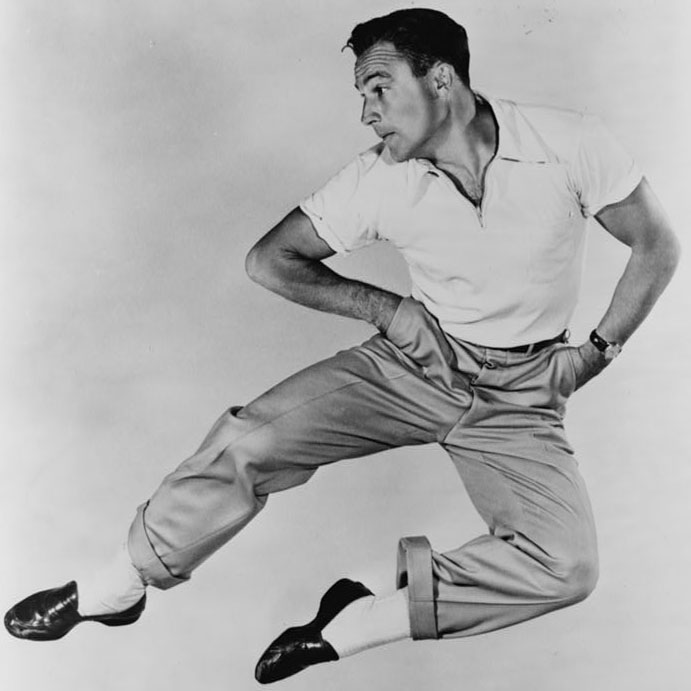
Today is Gene Kelly’s 100th birthday (born August 23, 1912), and I’ve been waiting for a year to talk about it!
One thing that you just don’t see today is a lot of movie musicals. Sure, Chicago is pretty fabulous and started a pretty minor movie musical revival. But I’d argue that nothing comes close to the MGM musicals of the 1920s-1940s in any way: performers, material, costume design, set design, direction, or historical/artistic significance. And in my opinion, one of the greatest triple (quadruple? quintuple?) threats to come from that era was Gene Kelly.
Then there are the little details that make my heart (closed to many these days) go pitter-pat. How his dancer thighs look in 1940s-era trousers. An expressive face that can go from furrowed brow to intimate smile in two seconds flat. Stories from his costars, from slipping a 19 year old Debbie Reynolds the tongue in the last shot of Singin’ in the Rain, to Cyd Charisse’s claim of his strength: “when he lifts you, he lifts you!” Knowing that he choreographed and performed in what is probably my all-time favorite movie musical number: “Prehistoric Man” from On the Town. Sigh!
Unfortunately I don’t know a lot about the real life Gene Kelly, but I’ve heard several anecdotes that lead me to believe he was by and large a swell guy. The only reason I haven’t already read more about him is that I enjoy his film persona so much and don’t want to find out any ugly secrets, like that his tap shoes were made out of kittens or something. A girl sometimes needs to keep hope alive, especially when it comes to people who make your heart go pitter-pat.
When I do face my fears about reading Gene Kelly biographies, I suspect I’ll be aiming to read Gene Kelly: A Life of Dance and Dreams by Alvin Yudkoff or Gene Kelly: A Biography by Clive Hirschhorn. There don’t seem to be a plethora of biographies on the market, or one that is more well-reputed than others though—so if you have any recommendations, suggest away!
Celebrate with me today by leaving a comment and sharing why you love Gene Kelly! Christopher Walken is away from his computer today, but wanted to share this tribute:
(That is, in terms of copywriting, editing, or research?)
Navigate over to Bookish Freelance Services to see my current rates and some work samples. That corner of this website is likely to evolve over time, so check in now and again for surprises large and small.
Over the past several months I’ve noticed that comics and graphic novels are becoming a significant part of my reading list. Part of me wants to argue that it’s not really reading at all, since it’s fun and I can get through a whole book in just a few hours. However that part of me usually gets stuffed into a dark closet by the other part, which is having a lot of fun discovering all this great work that only takes a few hours to read.
Since 2004 I’ve been reading The Complete Peanuts, an ambitious series released by Fantagraphics in Seattle. They’re publishing two volumes a year (in May and November), each of which contains two years worth of Peanutsstrips by Charles Schulz. I fell behind in reading the series for a couple of years while I had a stressful job and no downtime, but just a couple days ago I finished the most recent release, 1983-1984. One of the things I enjoy about reading the series is to see how the strip evolved over time—how characters were drawn differently in the early years, reading the first appearance of things closely associated with the strip(football, anyone?), and encountering really obscure characters like the kid named 555 95472 (“5” for short) or tennis rivals Molly Volley and Crybaby Boobie. Now and again the books also give just a glimmer of the immense amount of historical research that has gone into producing the series, and of course that fans the flames of my heart almost as much as Snoopy does.
Another delightful read recommended to me by my friend Dana was Pyongyang: A Journey in North Korea by Guy Delisle. This is another Drawn and Quarterly title, of course, it is exponentially easier for Canadians to get into North Korea than any American. In the book, Delisle offers up a travelogue that communicates his alienation while in North Korea, while he was almost never alone. He mediates on North Korean culture, pointing out amazing things—some that strike awe in the reader, some that leave us to chuckle. Reading this book showed me what I’d like to do with the Canada zine I’ve been quietly percolating about the last year—but given how poorly I draw, I suspect there will be no wildly popular Bookish Comics in my future. (Although I suppose if I could draw one thing and just recycle it, I’d be in business, like Dinosaur Comics.)
Given all these great discoveries, I’ve also put Persepolis on hold at the library, and hope to do the same with The Zen of Steve Jobs, which I noticed earlier this week when inside a comic book shop.
It seems that many of my discoveries have been through recommendations by other people. So, reader, tell me: which comic do you think is worth a read?
Recently my friend Chez wrote two blog posts entitled “Five Books That Won’t Impress a Girl” and “Five Books That Won’t Impress a Boy.” I’d like to steal that idea (or as someone I recently met suggested, consider it open source) and submit my own version. Here are some books you may want to hide away from your bookshelf, and certainly not tote along with you on a date.
Five Books That Won’t Impress a Girl
5. The iPad for Dummiesby Edward Baig. You need a Dummies book to explain what is arguably the easiest user interface ever created? Really?
3. Jack Chick tracts by Jack Chick. These are the hellfire and brimstone comics you may find stuffed into your screen door when you come home from work. Either this person is very into Jesus or collecting these out of an ironic hipster spirit. Either way, it is acceptable grounds for their date running away.
1. Learn Just Enough…To Get Laid by Tyler DeAngelo and Brad Emmett. You’ve just told her two things about yourself: you are not very smart, and all you want is sex.
5. Fat is a Feminist Issue by Susie Orbach. This is the only one on this list I’ve got on my bookshelf. If you’re trying to impress another woman, sure. If you’re trying to impress a man, I see two warning signs in the title, neither of which are the F word he wants to be hearing.
3. Kardashian Konfidential by the Kardashian whatevers. Easily interchanged with anything by a Snooki, Paris Hilton, or anyone else who has ever had a “reality” show on a secondary cable channel. (Guys, that includes You Can Run But You Can’t Hide by Dog the Bounty Hunter!)
1. Wedding Planning for Dummiesby Marci Blum and Laura F. Kaiser. You’re looking at her bookshelf for the first time and she’s planning her wedding? Run. Fast.
Honorable Mention: The Twilight series by Stephenie Meyer. You’ve just told him two things about yourself: you have a lot of time to be reading poorly written romance novels, and you may be a necrophiliac.
I’ll be giving a presentation later this month at Portland, Oregon’s Central Library. Join us!
Information or Inspiration? Improving Your Non-Profit’s Publications
How can your non-profit’s member publication forward its mission? We’ll explore the case study of one national non-profit and its comparable organizations, then discuss how a non-profit’s publication can keep its members clamoring for more.
Wednesday, June 27, 2012 at 6pm US Bank Meeting Room (First Floor), Central Library 801 SW 10th Ave, Portland OR This presentation is free and open to the public. No reservation necessary, but you can help with cookie-planning by reserving here.
Heather Andrews has over a decade of experience working with non-profit organizations. She recently earned her Master of Publishing degree through Simon Fraser University (Vancouver, BC).
Ever have that one class where you work really hard and still don’t quite make it to an A—but in the process you absorb oodles of valuable information that will still be on your mind years later? For me, that was our editing class during MPub. While I’m pretty strong in the stylistic and copyediting department, this course served as a big reminder of just how far I have to go.
Since coming back to Portland, I’ve thought about marketing my editorial/writing services to friends and acquaintances for a relatively low price in order to keep building my expertise, increase my experience, and supplement my day job’s cash inflow. Is it worth all the trouble to market your services though, if your potential clients don’t even realize how many usage errors are on their resume, or that a proposal is much too technical for the intended audience?
Enter my friend Sarah.
Sarah is a writer too, and knows that when you’ve been looking at a piece of your own writing for too long, your own eyes miss things that fresh eyes will catch in seconds. Over the past six months she has sent me a few short pieces that she wrote before submitting to publishers, in hopes of having a second set of eyes to help polish the final product. Because the pieces have been short, I’ve been able to easily fold it into my day.
We’ve got a bit of a system worked out, which we never really discussed as an “agreement” but which works really well for both of us. She sends me her writing and gains the benefit of feedback, and I get to work at developing my editorial skillset.
Oh yeah—and she sends me presents afterward!
In the past she has sent me a box of Coconugs from Mexico, packages of tea from Montana Tea and Spice (I forgot to try/buy some before leaving Missoula!), and more. Most recently I got a box with a plastic bag of almonds and some homemade cookies. The almonds were from the kibbutz where her mother used to live in Israel!
The point is that Sarah acknowledges the value of my work. Her sunny personality always makes me excited to hear from her anyway, but we have a mutually beneficial system. Traditional payment is absent, but we’re both happy.
When you ask someone for a favor that draws upon their special skills, make sure to be clear you value it. Whether your value shows up as cash, a batch of homemade cookies, or simply a heartfelt thank you (or a combination of the above!), genuine gratitude and acknowledgement of someone’s time and effort will mean they’re more willing to help you again in the future.
Sarah and her fiancé Josh just left yesterday for a six month bike trip they’re undertaking, traveling from Alaska to Mexico—check in with their progress at Real Big Fun!
On Monday, April 23rd, I trudged around Vancouver BC obtaining approval signatures, then submitted my project report to the SFU Theses Office. The next morning I picked up some of my favorite cinnamon rolls, closed my Canadian bank account, and went home.
As a follow-up to my FAQ blog post about the SFU MPub program, I’m going to talk a little bit about the process of doing the project report in this post. It happens that on this topic I’ve actually been getting more questions from my fellow students than prospective students. Of the 20 people in our cohort, I believe a total of only seven of us have submitted our project reports one semester later than the program’s timeline. In other words, even after an extra semester, only 1/3 of my fellow students are done with the program.
Like many MPub classmates, I had basically taken the fall off to tend to other matters. I spent about three months working in my house so I could move back in. On the last day of December, some sobering circumstances led me to vow that I would complete my project report in the spring semester, which would mean handing in the final version by April 27th. As accountability helps me achieve goals, I sent a massive email asking friends to check in with me periodically, and I even wrote a blog post about my 750 word daily goal to get the rough draft hammered out.
Writing the rough draft in January was probably the toughest part of the process. It took a couple of hours agonizing that first day before I just decided to freewrite it: write all the ideas that had been percolating in my head, just to get them on paper. After that I started expanding as I could on this or that idea, adding words, and I was able to start structuring the thing to match the outline and proposal I had previously submitted. It was tough going, but the first draft got plopped into InDesign and sent out a couple days before January 31st.
InDesign was a bit of a pain until the very end—for every version I submitted, I needed to reflow all the text in the document, and I was having footnote numbering issues. In early April it took a friend and I several hours to unlock all the mysteries, even after receiving advice from one of my MPub professors.
Fortunately my senior advisor never sat on anything too long. Of course, I deliberately chose him because I knew we would have a great working relationship compared to my other option. And we did! Starting in January I clearly stated to him my intention of finishing in one semester, and I’d like to think that teamwork made it happen. Toward the end, he even gave me a little insider advice to get the quickest turnaround from one of my other committee members.
One thing that was never spelled out to me was this: while everybody knows you are allowed three submittals to produce your final product, only your senior supervisor will see it at first. Mine told me when I was “clear” to send it to the other two. This was slightly nerve-racking considering we were nearly in April at that point, and either of them might have had a lot to say about what I wrote.
Fortunately none of my drafts needed vast amounts of content work—most of it focused on my comparative section, which was weak because neither of the two organizations really helped me when I contacted the current staff. Once I sent my last draft to the other two committee members, I got very few content corrections, but many copy edits from our resident editor. Those took me about two days to work through. In the process I got a glimpse of the most common errors in my writing, which was a real treat. (Note to self: review that vs. which! Stop inverting sentences!)
Obtaining the requisite signatures in Vancouver was the best part of my trip. My senior advisor and other SFU advisor gathered in our program coordinator’s office and the mood was giddy. It was great to see them having such fun! Of course the tall Oregon microbrews and thank you cards I brought them probably didn’t hurt. Then it was off to Burnaby to wait in line at the Theses Office.
Dealing with the thesis office was more problematic. They have a series of guidelines available on their website which, like everything else on SFU’s website, were fairly difficult to understand. I started referring to one of the guideline lists as the “three easy steps” document—these “three easy steps” took about four solid pages of text, printed out, with a fair amount of that text in red, to provide an overview of the thesis submission process. Their help site has multiple types of instructions to cover different type of theses and dissertations, from the breadth of SFU departments. Our program gave us an InDesign template to use for our project report, but as I carefully combed through the Theses Office guidelines, suddenly I was questioning whether the typeface I had chosen was acceptable, among other things.
The reason I was being so careful? Of course, I didn’t want to drive from Portland to Vancouver only to be turned away for a minor detail I had gotten wrong. So the woman who runs the Theses Office got familiar enough with me that when I was finally sitting face-to-face with her, I only had to introduce myself as “the one from Portland.” After having sat in line for an hour and a half to see her (no, I’m not kidding), our conversation was slightly terse as she pointed out the two(!) errors on my cover page. There are only a few things they check during the intake process, and they are very exact about the cover page.
Planning to add a comma to “Faculty of Art, Communication and Technology” so the Oxford comma will be consistent with the rest of your project report, using the guidelines your department has set? Whoop-whoop! Call the thesis police!
It may have been the eyeballs popping out of my head and the flurry of detailed questions that followed, but we compromised—if I would fix my cover page and send it back electronically, she could reprint it in their office on archival-quality paper. This turned out to be ideal for me—if she had required me to reprint it myself I would have needed to buy a copy card to print out two sheets of paper. At a library that I would likely never find myself in again.
Originally I was planning to attend graduation, but last week those plans changed. When I was in Vancouver delivering my thesis, I asked various SFU staff if there were any other costs associated with being in the commencement ceremony. Nobody had reason to believe so, and I couldn’t find any mention on the commencement website, so I closed my Canadian bank account before leaving. Only after I confirmed my attendance online this week was any mention made, and I still had to proactively call the graduate studies office to find out that yes, for the past two years there has been a $35 charge for students to rent the regalia. Factoring in many other considerations and finally fed up with SFU’s poor communication to students, I requested to cancel my confirmation. On June 15th, my mom and I plan to attend a private graduation ceremony at a local restaurant and spend—you guessed it—$35.
Do you have any other questions about the project report process? Ask away!
A few people I know publicly call attention to the errors in others’ written communication. They get pretty judgmental about it, too. The big offense could be the the wrong they’re, or the use of a greengrocer’s apostrophe. One person even went so far as to declare after stating the offending error, “I didn’t know you were that kind of a person.”
Then almost without skipping a beat, they’ll begin a sentence “Me and Robert…” or have some subject-verb agreement issues in their writing.
“You’re judged by your writing!” they remind us. Indeed. Yet there are plenty of people who know the language but don’t seize every opportunity to hold an error over somebody else’s head. We commonly make them ourselves—because nobody’s perfect.
Consider Muphry’s Law, a term coined by an Australian editor. The law acknowledges if you are pointing out someone’s written errors, you too will make an error in doing so. The stronger the sentiment, the greater the fault.
Of course we should be striving for great English. Above that though, shouldn’t we also be striving to be great people? And great people, I think, don’t need to vehemently condescend to those who have made an error.





 bookish