Category Archives: Uncategorized

Bookish Heather for Hire

Ever feel like you need some professional help?

(That is, in terms of copywriting, editing, or research?)

Navigate over to Bookish Freelance Services to see my current rates and some work samples. That corner of this website is likely to evolve over time, so check in now and again for surprises large and small.

Leave a comment

Filed under Uncategorized

Comics

Over the past several months I’ve noticed that comics and graphic novels are becoming a significant part of my reading list. Part of me wants to argue that it’s not really reading at all, since it’s fun and I can get through a whole book in just a few hours. However that part of me usually gets stuffed into a dark closet by the other part, which is having a lot of fun discovering all this great work that only takes a few hours to read.

One of my favorite recent reads has been Hark! A Vagrant, a compilation of the best web comics by Kate Beaton. One of my favorite comics looks at the Brontë sisters. Brainy, witty, and starring many historical figures, I feel like if I was a comic, it would be this one. Dani, one of my MPub classmates, turned me on to the series. And then she went on to intern for Drawn and Quarterly, the book’s publisher!

Since 2004 I’ve been reading The Complete Peanuts, an ambitious series released by Fantagraphics in Seattle. They’re publishing two volumes a year (in May and November), each of which contains two years worth of Peanuts strips by Charles Schulz. I fell behind in reading the series for a couple of years while I had a stressful job and no downtime, but just a couple days ago I finished the most recent release, 1983-1984. One of the things I enjoy about reading the series is to see how the strip evolved over time—how characters were drawn differently in the early years, reading the first appearance of things closely associated with the strip (football, anyone?), and encountering really obscure characters like the kid named  555 95472 (“5” for short) or tennis rivals Molly Volley and Crybaby Boobie. Now and again the books also give just a glimmer of the immense amount of historical research that has gone into producing the series, and of course that fans the flames of my heart almost as much as Snoopy does.

Another delightful read recommended to me by my friend Dana was Pyongyang: A Journey in North Korea by Guy Delisle. This is another Drawn and Quarterly title, of course, it is exponentially easier for Canadians to get into North Korea than any American. In the book, Delisle offers up a travelogue that communicates his alienation while in North Korea, while he was almost never alone. He mediates on North Korean culture, pointing out amazing things—some that strike awe in the reader, some that leave us to chuckle. Reading this book showed me what I’d like to do with the Canada zine I’ve been quietly percolating about the last year—but given how poorly I draw, I suspect there will be no wildly popular Bookish Comics in my future. (Although I suppose if I could draw one thing and just recycle it, I’d be in business, like Dinosaur Comics.)

Here are a couple more random comics I’ve enjoyed quite a bit as of late. Today’s Sheldon Comics features an infographic about why novels are the size they are. An older comic that I’ve seen circulating around the internet quite a bit this week about lesser-known editing and proofreading marks was drawn by someone I know. And of course I love Roz Chast, who had a piece in The New Yorker this week about life before the internet.

Given all these great discoveries, I’ve also put Persepolis on hold at the library, and hope to do the same with The Zen of Steve Jobs, which I noticed earlier this week when inside a comic book shop.

It seems that many of my discoveries have been through recommendations by other people. So, reader, tell me: which comic do you think is worth a read?

Leave a comment

Filed under books, zines

Five Books That Won’t Impress Your Date

Recently my friend Chez wrote two blog posts entitled “Five Books That Won’t Impress a Girl” and “Five Books That Won’t Impress a Boy.” I’d like to steal that idea (or as someone I recently met suggested, consider it open source) and submit my own version. Here are some books you may want to hide away from your bookshelf, and certainly not tote along with you on a date.

Five Books That Won’t Impress a Girl

5. The iPad for Dummies by Edward Baig. You need a Dummies book to explain what is arguably the easiest user interface ever created? Really?

4. The Catcher in the Rye by J.D. Salinger. You’re a tortured loner. Got it.

3. Jack Chick tracts by Jack Chick. These are the hellfire and brimstone comics you may find stuffed into your screen door when you come home from work. Either this person is very into Jesus or collecting these out of an ironic hipster spirit. Either way, it is acceptable grounds for their date running away.

2. Generation Ex: Adult Children of Divorce and the Healing of Our Pain by Jen Abbas and Elizabeth Marquardt. Help your date prepare by telling her to bring a handkerchief for you and a tarp so she doesn’t get her dress wet. From the tears, you sicko!

1. Learn Just Enough…To Get Laid by Tyler DeAngelo and Brad Emmett. You’ve just told her two things about yourself: you are not very smart, and all you want is sex.

Honorable Mention: A Geek’s Guide to Get Laid! Have Sex Even if You’re Fat, Ugly, or Worse by Dave Briner. Not only are you desperate, but it seems you lack self-esteem. Is that the “worse” part?

Five Books That Won’t Impress a Boy

5. Fat is a Feminist Issue by Susie Orbach. This is the only one on this list I’ve got on my bookshelf. If you’re trying to impress another woman, sure. If you’re trying to impress a man, I see two warning signs in the title, neither of which are the F word he wants to be hearing.

4. Joint Custody with a Jerk: Raising a Child with an Uncooperative Ex by Julie Ross and Judy Corcoran. Baggage, emotional and physical. Plus, a potential to get punched in the klavey by the ex.

3. Kardashian Konfidential by the Kardashian whatevers. Easily interchanged with anything by a Snooki, Paris Hilton, or anyone else who has ever had a “reality” show on a secondary cable channel. (Guys, that includes You Can Run But You Can’t Hide by Dog the Bounty Hunter!)

2. Pride and Prejudice by Jane Austen. If you’re really into Mr. Darcy, I suggest listening to “Oh Mr. Darcy” by the Doubleclicks.

1. Wedding Planning for Dummies by Marci Blum and Laura F. Kaiser. You’re looking at her bookshelf for the first time and she’s planning her wedding? Run. Fast.

Honorable Mention: The Twilight series by Stephenie Meyer. You’ve just told him two things about yourself: you have a lot of time to be reading poorly written romance novels, and you may be a necrophiliac.

What would be on your list?

1 Comment

Filed under books, Uncategorized

Information or Inspiration? Improving Your Non-Profit’s Publications

I’ll be giving a presentation later this month at Portland, Oregon’s Central Library. Join us!

Information or Inspiration? Improving Your Non-Profit’s Publications

How can your non-profit’s member publication forward its mission? We’ll explore the case study of one national non-profit and its comparable organizations, then discuss how a non-profit’s publication can keep its members clamoring for more.

Wednesday, June 27, 2012 at 6pm
US Bank Meeting Room (First Floor), Central Library
801 SW 10th Ave, Portland OR
This presentation is free and open to the public. No reservation necessary, but you can help with cookie-planning by reserving here.

Heather Andrews has over a decade of experience working with non-profit organizations. She recently earned her Master of Publishing degree through Simon Fraser University (Vancouver, BC).

1 Comment

Filed under Uncategorized

Editing for Almonds (Like Peanuts, Only Fancier)

Ever have that one class where you work really hard and still don’t quite make it to an A—but in the process you absorb oodles of valuable information that will still be on your mind years later? For me, that was our editing class during MPub. While I’m pretty strong in the stylistic and copyediting department, this course served as a big reminder of just how far I have to go.

Since coming back to Portland, I’ve thought about marketing my editorial/writing services to friends and acquaintances for a relatively low price in order to keep building my expertise, increase my experience, and supplement my day job’s cash inflow. Is it worth all the trouble to market your services though, if your potential clients don’t even realize how many usage errors are on their resume, or that a proposal is much too technical for the intended audience?

Enter my friend Sarah.

Sarah is a writer too, and knows that when you’ve been looking at a piece of your own writing for too long, your own eyes miss things that fresh eyes will catch in seconds. Over the past six months she has sent me a few short pieces that she wrote before submitting to publishers, in hopes of having a second set of eyes to help polish the final product. Because the pieces have been short, I’ve been able to easily fold it into my day.

We’ve got a bit of a system worked out, which we never really discussed as an “agreement” but which works really well for both of us. She sends me her writing and gains the benefit of feedback, and I get to work at developing my editorial skillset.

Oh yeah—and she sends me presents afterward!

In the past she has sent me a box of Coconugs from Mexico, packages of tea from Montana Tea and Spice (I forgot to try/buy some before leaving Missoula!), and more. Most recently I got a box with a plastic bag of almonds and some homemade cookies. The almonds were from the kibbutz where her mother used to live in Israel!

The point is that Sarah acknowledges the value of my work. Her sunny personality always makes me excited to hear from her anyway, but we have a mutually beneficial system. Traditional payment is absent, but we’re both happy.

When you ask someone for a favor that draws upon their special skills, make sure to be clear you value it. Whether your value shows up as cash, a batch of homemade cookies, or simply a heartfelt thank you (or a combination of the above!), genuine gratitude and acknowledgement of someone’s time and effort will mean they’re more willing to help you again in the future.

Sarah and her fiancé Josh just left yesterday for a six month bike trip they’re undertaking, traveling from Alaska to Mexico—check in with their progress at Real Big Fun!

1 Comment

Filed under Uncategorized

Muphry’s Law

A few people I know publicly call attention to the errors in others’ written communication. They get pretty judgmental about it, too. The big offense could be the the wrong they’re, or the use of a greengrocer’s apostrophe. One person even went so far as to declare after stating the offending error, “I didn’t know you were that kind of a person.”

Then almost without skipping a beat, they’ll begin a sentence “Me and Robert…” or have some subject-verb agreement issues in their writing.

“You’re judged by your writing!” they remind us. Indeed. Yet there are plenty of people who know the language but don’t seize every opportunity to hold an error over somebody else’s head. We commonly make them ourselves—because nobody’s perfect.

Consider Muphry’s Law, a term coined by an Australian editor. The law acknowledges if you are pointing out someone’s written errors, you too will make an error in doing so. The stronger the sentiment, the greater the fault.

Of course we should be striving for great English. Above that though, shouldn’t we also be striving to be great people? And great people, I think, don’t need to vehemently condescend to those who have made an error.

Leave a comment

Filed under Uncategorized

A Fun Game for Bookish Library Nerds

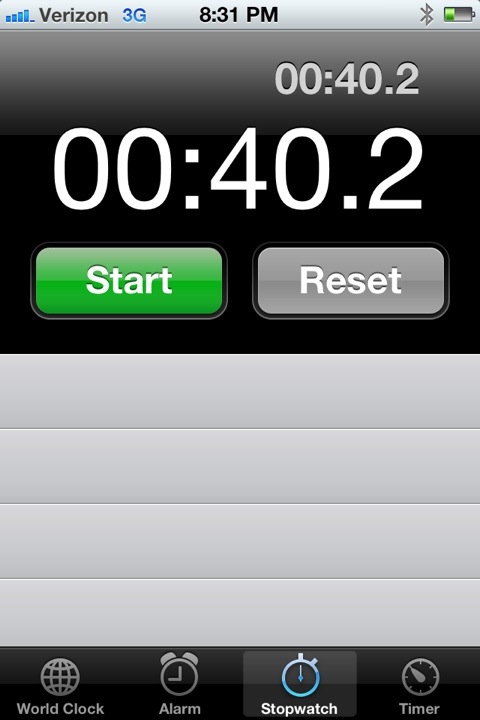
20120518-203142.jpg

1. Go to a library you’ve never been to, or at least never pulled anything from the stacks.

2. Arm yourself with a stopwatch and the call number of a desired book. (Important: confirm the book is actually available and checked in.)

3. Start the stopwatch and see how long it takes you to find the book in the stacks you’re seeing for the first time!

4. Watch as your mother looks slightly horrified and passersby chuckle at you, not with you. Overhear strangers mumbling something about a cameo on Portlandia.

5. When you’ve located the desired book, do a victory dance!

6. Bonus: When checking the book out, brag to the librarians about your time. Don’t forget to pay your library fines!

NOTE: I would just like to say this exercise actually took me 38 seconds, but it took another two seconds to press the STOP button.

Leave a comment

Filed under books

A Readin’ Machine (Or, Squeezed Out)

Earlier this year I set a goal: as a participant in the Goodreads reading challenge, I would aim to read 12 books this year. On April 15th, I met my goal.

Over the last couple of months reading has been my primary downtime activity. I’ve read books in less than 24 hours while waiting for feedback on the latest draft of my project report, waiting for the Portland rain to subside, or just because I was so excited to finally read the thing.

I unloaded much of my library before my temporary move to Canada, but plenty of books remain that need to be read. I’ve read newly acquired books, borrowed books, and library books. I’ve sold a few back to Powell’s since reading them, and plan to continue paring down my library once I’ve read some more titles. This isn’t even including the magazines I’ve piled up, nor the scholarly articles about bikes I found on JStor a couple weeks ago that I want to read just for fun.

A few of the books I’ve read have inspired some wistful nostalgia. Ever since getting back to Portland it seems my brain has soured a fair amount on my hometown. (I’ve a half-written blog post about this, but it’s a weighty topic, likely to be unpopular with most of the transplants I know, so I’ve been keeping it to myself—for now.) Reading three books in a row that reminded me of Portland Past then, was enough to push me into a full-on nostalgia bender.

The first book was Dark Horse’s recent release The Green River Killer: A True Detective Story. Sure, this is a story primarily set in Seattle, but as a Pacific Northwesterner growing up in the 80s, Green River Killer news (also Diane Downs news) was pretty pervasive. When I was a kid, my mother’s favorite books were true crime novels, and I sometimes I picked up her books and browsed the photo plates in the center. Let me tell you something: you cannot un-see some of the photos in those books.

Next was Beverly Cleary’s memoir A Girl from Yamhill. Portland’s own literary hometown heroine, Beverly Cleary was born in the Willamette Valley south of the city but spent much of her childhood in NE Portland, the setting of her Ramona books (and current site of the Beverly Cleary Sculpture Garden). I picked up the memoir at Goodwill for a couple of bucks. So much time had passed since its original release I wasn’t expecting to find it as utterly engrossing as I did. In the book, I discovered that Ramona is essentially based on Cleary herself as a child, and the book includes some very specific incidents that I remember were written into Ramona the Pest.

The book also illuminates moments when Cleary was encouraged by teachers in specific ways that set her on course for her adult career. In one masterfully written passage, she talks about her mother often encouraging her to “try.” When she takes this message to heart and enters an essay contest at a local grocery store. She wins—because no other children entered the contest:

“This incident was one of the most valuable lessons in writing I ever learned. Try! Others will talk about writing but may never get around to trying.” (p. 132)

Given the amount of care I spend on blog posts (and nearly everything else I write), often I wonder why I continue. This is the reason: I am trying. And even if nobody sees my online opining, I’m continuing to develop my writing for future professional writing opportunities.

Where does the nostalgia come in? In the beginning of the book, Cleary writes about Oregon weather masterfully, as if she too has patiently sat through as many Oregon winters as I have, waiting for the spring:

“I stood at the window watching the weather, the ever-changing Oregon clouds that sometimes hung so low they hid the Coast Range, rain that slanted endlessly on the bleak brown fields, stubble stiff with frost, and, sometimes, a world made clean and white by snow.” (p. 30)

Later in the book she paints a vivid picture of Depression-era Portland, peppering the text with references from the past. In fact, at two points she draws attention to phrases Portlanders say, and that’s where the real nostalgia set in. She remarked on Portlanders observing “the mountain is out today.” Of course, “the mountain” is Mt. Hood, being “out” refers to being able to see it on a non-overcast day, and that is a phrase I’ve neither heard, nor used myself, for years. It set my brain on a path of thinking about the ways in which Portland has changed over the past decade as the city has become more notable nationally and internationally.

Perhaps the area of Portland that has changed most in the past decade is NE Portland, and the next book I read just happened to take place there in the 1980s. The Girl Who Fell From the Sky is the current Everybody Reads book at Multnomah County Library, and I wouldn’t have read it had there not been a free copy at the circulation desk of my local branch when I visited. At certain points this book described a place and time in the past that I personally experienced. When the 1988 death of Mulugeta Seraw was referenced as a current event, this book ignited some synapses that hadn’t been fired in years. (If you’re not familiar, read A Hundred Little Hitlers by Elinor Langer.)

Since reading these three titles in a row (pure coincidence!) I’ve moved on to other fare. For a few days though, I was thinking about the Portland Past, both the one I have directly experienced and the one that belongs to my dead relatives’ memory. While I am glad I’ve gotten to know many of the transplants who have arrived in the last ten years, a small part of me feels like I’m being edged out by an invasive species. As the narrator in Said the Whale’s song “False Creek Change” laments about her hometown of Vancouver, BC, “there’s no room for me here anymore, anymore, there’s no room for me here anymore.”

If you’re interested in following my reading habits, this is my page on Goodreads.
7 Comments

Filed under books, history

The E-book as DVD

Deleted scenes are one of my favorite parts of watching movies on DVD. After the feature I see material that was cut for time or pacing, according to the accompanying introduction or director commentary. The cut footage often lends additional information to one of the film’s subplots or a character’s relationship. It’s tough to leave this material out, but including it on the DVD probably provides some solace to the creators.

One of the more intriguing ideas that has stuck with me from MPub lectures is the idea of marketing electronic books like DVDs. In the early 1990s (approximately), consumers were happy to re-purchase all their old VHS movies on the newer technology, despite the added cost, because of “bonus features.” Now, publishers are looking for ways to pay the technological costs of e-book production (and dwindling print sales). In a couple of MPub classes the possibility of similar value-adds were discussed, like short “behind the scenes” films, author interviews, book trailers, and the like.

How do you think an e-book would deal with a deleted scene?

David Sedaris already tests his pieces out on several audiences before they get published in book form. They may appear in The New Yorker, or excerpts may be read at his speaking engagements and notes about audience reaction taken into account as he continues working on the piece. Surely he has taken that feedback and made cuts from time to time.

Writers vary in their process, but it’s also pretty common to edit as you go along, realizing at the end of a paragraph you’ve gone off on a tangent. Writing on computers means these “deleted scenes” could be lost with just a couple mouse clicks, as many writers self-edit as they work.

Would you be more likely to buy a book that had material that had been edited out? If you think you would, consider the case of “What We Talk About When We Talk About Love” by Raymond Carver. One could argue that the “Raymond Carver-ness” of the story is mostly absent in its original form: as seen in the linked reprint, editor Gordon Lish had a lot to do with creating the writing style Carver is known for.

I might be interested in marked-up versions of stories like that only occasionally—mostly for the education to improve my writing, and maybe to remind myself that the best writers are human too.

The value-add that I could see working on me is annotated texts. Great ones exist: my favorite is The Annotated Alice by Lewis Carroll, with notes by Martin Gardner. Considered a classic, the notes explore various mentions in the text. For example, an offhand comment by Alice about walking into a mirror-world yields a discussion of matter (the real world) coming into contact with anti-matter (the molecules in the mirror-world) and why they would spontaneously combust. A particularly specific illustration points out the historical royal the caricature is based on. The poem “Jabberwocky” yields four full pages of information.

In addition to The Annotated Alice, I also own The Annotated Lolita by Vladimir Nabokov. It was my first time reading the novel, but I suspect my appreciation for the work is directly related to additional information illuminated by the notes. And while I haven’t had a chance to read it yet, I discovered the existence of The Annotated Uncle Tom’s Cabin last year while doing research for an MPub paper, and look forward to diving into that novel one of these days.

Folding annotation in as an “added feature” to ebooks may result in that format looking like an average hyperlinked web page, interrupting the reading experience when one is required to click back and forth from original text to notes. Notes in The Annotated Alice stylishly lie in the margins of the book next to the relevant text. Readers could choose to absorb the note, or not, without much more than a movement of the eye.

What sort of “bonus features” would you like to see in the books of the future? Would the inclusion of “bonus features” influence how quickly you embrace ebook technology?

4 Comments

Filed under books

On The Death of the Monkees’ Davy Jones

Davy Jones died today.

This is probably not the proper way to begin, but as a longtime Monkees fan I need to say Davy has never been my favorite Monkee. As a Monkee he seemed perfectly happy playing the cookie cutter heartthrob and didn’t offer much else. Much complexity. Women still swooned over him (rubes!), but this woman has never liked what the crowd falls for so easily.

However, Davy had a considerable talent for musical theater. Pre-Monkees, he was Tony-nominated for his role as the Artful Dodger in the original stage production of Oliver! (The cast performed on the Ed Sullivan Show the same night the Beatles debuted in the US.) Some of Davy’s most memorable Monkee moments come from showcasing this talent in later years before the group broke up—from the “Daddy’s Song” sequence (with Toni Basil!) from the Monkees’ movie Head, to the “Goldilocks Sometime” song in the misguided television special 33 1/3 Revolutions Per Monkee.

Aside from his more musical theater-oriented pieces, he also recorded a single in the 70s which is my all-time favorite Davy Jones song. (Well okay, “Hard to Believe” is an uncharacteristically beautiful piece that I also enjoy.) “Rubberene” tells the story of a man’s relationship with his blow-up doll. If you have a Blip login (I don’t), you might be able to listen to it here. Finally—the one-dimensional heartthrob got a sense of humor! Sadly though, the record is an extreme rarity as it was never commercially released, and by the time the Monkees reunited for their 25th anniversary in 1986, Davy was back to playing his same role.

After that big Monkees resurgence in the late 1980s, Davy Jones also became an author. His first book was a memoir called They Made a Monkee Out of Me (above), and the second book he is credited with is an early Photoshop fantasia (or nightmare) called Mutant Monkees Meet the Masters of the Multi-Media Manipulation Machine (you know it’s from the early days of digital media, as “multimedia” is still hyphenated)When I was in eighth grade, I chose They Made a Monkee Out of Me for a book report presentation. My mom even sewed a Monkees shirt for me, which I wore on the day of my presentation. Being passionate about talking about the Monkees and even dressing the part, of course I got an A. 😉

After reading about Mike Nesmith’s cataract surgery, recently I had been pondering the state of Monkee mortality. As Davy Jones heads to his locker, I am sad to see my wonderings are starting to be realized. It will also be interesting to see what legal battles ensue between Davy’s very young new wife Jessica Pacheco, and the four grown children from his previous two marriages. (Watch them on a train-wrecky reboot of “The Newlywed Game.”)

Davy will be missed, for sure—but I truly dread the day I hear about Mike Nesmith or Peter Tork joining him.

1 Comment

Filed under books, history