
Doggy Cancer, Bad Juju, and Constructive Wallowing

About a month ago, my dog Atticus was diagnosed with cancer.

Tom, one of the vet clinic staff who adores Atticus, asked me about our visit when we left the examination room. I told him the bad news. Tom expressed his sorrow and asked, “are you totally about to burst into tears?”

Of course not, I said. I talked about how we all have to die sometime, about how great of a life Atticus has had, about how my anxiety about his health would have to be right at some point.

In other words I was completely denying any feelings I had in the moment. (In hindsight, I think I was just still in serious shock about the news.)

Over the next two days I was more or less a non-functioning mess.

What if I had continued the same nonchalant approach after leaving the vet’s office? Perhaps I might have said some of the following:
He’s just a dog, not my child.
We’ve all gotta die sometime.
No big deal.
When in fact this is a huge deal. Atticus has lived with me in two countries, two states, and accompanied me on countless adventures. Friends who know me, know my dog. I have essentially structured my life around him for the last 12 1/2 years—health issues and personality quirks and all. Raising my first dog was no small feat.

A month before Atticus’ diagnosis was confirmed, Tina Gilbertson released her first book, called Constructive Wallowing: How to Beat Bad Feelings By Letting Yourself Have Them.

In the book, Tina talks about the detrimental effects of emotional constipation—not allowing yourself to have feelings. Tina’s discoveries began when she was an aspiring actor in Los Angeles:

I was thinking about a young woman in my [acting] class who was not only a talented actress, but also smart, funny, utterly charming, and easily twice as pretty as me. She was seriously cramping my style; I wanted to be the best actress, the “phenom,” in that class…

As I drove home from class that day, I was aware of vaguely ‘icky’ emotions trying to rise up inside me. I didn’t exactly know what I was feeling, I just knew it was bad. I didn’t want to feel bothered by the situation in acting class. But I was bothered…

Spontaneously, I decided to speak my feelings aloud.

Tina then discovered that the act of speaking and acknowledging her feelings helped her feel better. When she wasn’t struggling against the feelings, they didn’t have a secret control over her. She eventually detoured from her Hollywood aspirations and ended up becoming a counselor.

Tina’s book walks readers through various obstacles that might keep them from the process of acknowledging their feelings. Perhaps you’re your own worst critic, telling yourself that other people have it way worse (#firstworldproblems!) or that whatever you might be feeling is stupid or selfish. Using insightful analogies, she walks the reader through each obstacle with kindness, and even some wit thrown in.

And anyone who may be thinking that acknowledging your own feelings will turn you into a scenery-chewing Hamlet, it turns out that acknowledging your feelings is not the same thing as choosing your behavior. If your boss has taken credit for your work, it is enough that you understand how you feel about that—this book is not advocating that you tell your boss or coworkers how you feel, or retaliate by putting rat poison in his coffee.

ConstructiveWallowing

Having feelings is quite natural, she says, and the message is even drawn out in the book design. Natural colors are used in the cover design that incorporates a rainy theme, with a raindrop-on-water motif sprinkled throughout the inside pages. Normally I’m less apt to notice book design, but the design choices in this book seemed to be supporting the overall theme.

As you can imagine, Atticus’ cancer diagnosis certainly gave me an opportunity to review and practice the book’s contents pretty quickly after I was finished reading! In the past I’ve certainly been guilty of holding things to the detriment of my own mental health, but this was one instance when it was almost a non-issue. The feelings just happened. Like Tina, I’ve found that for the most part, knowing how you feel is crucial to resolution.
1 Comment

Filed under books, dogs

Workshopping With and Fangirling Over Kim Stafford

Lewis and Clark College, my alma mater, has a long-standing connection with the family of William Stafford. Oregon’s Poet Laureate from 1975-1990, Stafford wrote poetry about nature, pacifism, and Oregon, and had a long teaching career at Lewis and Clark.

Kim Stafford, William’s son, has had an equally impressive career. He has taught much of his adult life at Lewis and Clark, founded the college’s Northwest Writing Institute, and writes brilliantly. This winter I read his most recent work, 100 Tricks Every Boy Can Do: How My Brother Disappeared, which was nominated for an Oregon Book Award in creative non-fiction this year.

As an undergraduate student at Lewis and Clark I had the opportunity to listen to Kim close the campus’s Last Lecture series for the year. He brought his guitar and sprinkled songs between thoughts about the importance of being true to yourself—embracing all your interests rather than giving up your guitar playing, say, to become a better mathematician. Do all the things, embrace life wholeheartedly instead of being a specialist. Over a decade later, and I still look back on this evening with great fondness.

You might say I’m a bit of a fan!

That’s why, when I heard about his Introduction to Digital Storytelling workshop, I was compelled to attend. I’m not a complete newbie—after all, I did produce “The Cycling Eight” at Adventure Cycling and have racked up quite a bit of educational media experience. An opportunity to work with Kim Stafford and to glean new storytelling approaches could be rather helpful!

CollinsHall

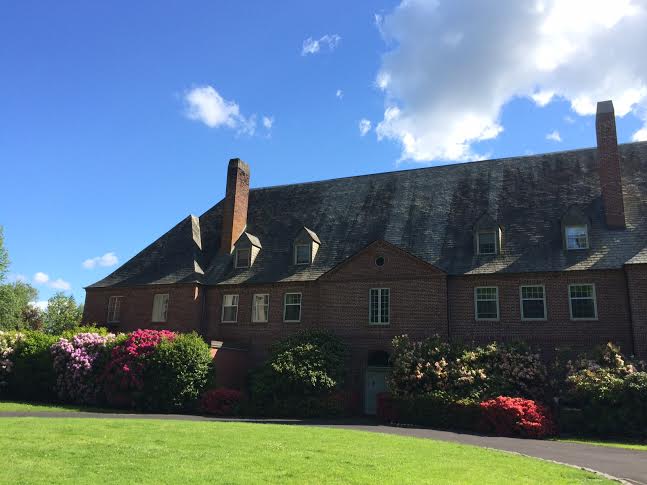
Journeying to the new Lewis and Clark graduate campus, I arrived early to check things out. I entered the chapel, our workshop space, and before I even sat I had an entire conversation with Kim! He walked right up and asked me about myself. We talked about the Sisters of St. Francis, the order of nuns that the property originally belonged to. We spoke of silent retreats at monasteries,  how we’d like to see more radicals in the church, and I told him about discovering the wonderful Trappist Abbey. Standing next to me, he took a photo of the same dove mural on the ceiling that I was photographing. Like we were already old buddies.

PeaceBird

The workshop, as it turns out, presented a specific way of telling personal stories modeled by the Center for Digital Storytelling.

In this example, Kim tells of the day his father narrowly escaped being hanged:
https://www.youtube.com/watch?v=366gBWUFo1M

Most of the workshop participants were professional educators with limited media tools, looking to take the idea to their students for classroom teaching. As a hired pen, it was hard to imagine incorporating the workshop content into my work life. And sadly, real life has time constraints that foil many of my creative project ideas. Still though, I was thinking about the class content the rest of the evening and into the next day.

One phrase Kim kept throwing around was “digital haiku.” This is the idea to make one’s digital story as succinct and brief as possible. Let the images communicate some things so you can take another few words away.

It gave me an idea:

As we filled out course evaluations at the end of the three hour workshop, Kim waited just outside the chapel doors. Students formed a receiving line, shaking his hand and I imagine covering him with praise. Eventually I headed up the back of the line, extolling my own praise and asking a question about that latest breathtaking book, a memoir about his brother’s suicide.

It was a real thrill to be Kim Stafford’s student for a few hours. He filled the room with warmth and a joyous smile, admiring so many of the deeply personal stories his students were brave enough to read out loud. He focused on drawing things out of his students rather than intimidating newbies with his own brilliant work.

Where will I go with this? It’s hard to say. Inspiration’s a funny thing—sometimes it shows up in odd places…

1 Comment

Filed under books

A Friend’s Legacy: Bryon Burruss and the Famous Tuscan Springs

BBCollage

Let’s say one day you’re at work, maybe feeling a little under-engaged with whatever it is you do. Someone you know crosses your mind, and you say, “hey, let’s give ‘im a Google!”

And about 20 seconds later, you learn that they recently died.

Last month, this happened to me. (“Local Author, Former Scribe Passes Away.”) Bryon died of a “massive heart attack” in his home on St. Patrick’s Day. He was discovered by his housemate. He was 48 years old.

Over the last few weeks since I went a-Googling, I’ve been ruminating over every detail about Bryon I can remember. Searching in my records for notes sent, remembering details, trying to make sense of how a close friend could be gone just like that. Having the random crying jag when I remember another detail of something that’s so important to me, that I may not know about if it wasn’t for him.

In Summer 2001, I met Bryon Burruss when I was in a Portland production of The Famous Tuscan Springs, a play he wrote with his friend Joe Hilsee. We started corresponding shortly thereafter, and the last time I heard from him was via text in August 2010, about two weeks before I was to move to Canada and start my graduate program. The last time I sent him a brief email was the following summer, when I was in Montana and my brain was starting to work again after a tumultuous year.

He had a master’s degree in theater but lived in rural California. Yet he managed to open a theater company and keep it running for five years. The theater encouraged aspiring playwrights each year by holding a new plays festival—submissions came from around the world. Those plays that didn’t quite make the stage were sometimes adapted for radio, which he produced.

Theater was Bryon’s love, possibly more than anything else in the world. The pains he took to keep that theater running were great.

Perhaps those are the facts that most people could tell you. What I alone could tell you is this: Bryon once suggested a medicinal tea which is still my go-to for colds, a decade later. I sent him the script of a favorite play—Killer Joe by Tracy Letts—and a year later his theater performed it. Bryon suggested I might like a Canadian television program called Slings and Arrows, which was about a Shakespeare company in Ontario. When I got the first season on DVD, I anticipated watching the first hour and then doing the dishes. Six hours later I was exhilarated, watching the final few minutes after I just could not turn the thing off. When Bryon was desperate for readers for his slush pile of new plays, I gladly helped out, reading in one case a rather large box of scripts over the course of just a few weeks.

Aside from theater, Bryon had another special project as well. The Famous Tuscan Springs, the play I was in, was a real place that existed outside of Red Bluff, California. In addition to writing a play about the place, Bryon knew pretty much all there was to know about the resort that sat there in the early part of the 20th Century. At one point, I helped him locate a booklet held in a medical library in New York City that he was previously unaware of.

BBTuscanSpringsBookCover

It turns out that when his life ended unexpectedly, Bryon was having some success with his Tuscan Springs research. Tuscan Springs was released by Arcadia Publishing under their ubiquitous “Images of America” series.

There are plenty of other things I could say about Bryon too. At times, he seemed to be anti-feminist. Once, when I offered a feminist take on something, he snarkily asked if I would start talking about herstory. My vegetarianism also seemed to make him uneasy—he tried to convince me that in the town he lived, you just couldn’t be vegetarian. And yet, I never had any problem feeding myself when I was there.

The worst thing I could say about Bryon is, I never got to say goodbye to him.

Naturally, I purchased a copy of Tuscan Springs. I never saw Bryon’s collection of imagery and artifacts on the few occasions we visited, but so far I’m impressed by what he managed to dig up over the years.

Readers, friends, to everyone I say—you make sure and take care of that heart of yours. Treat your body well. Cherish the relationships you have, even if they’re not perfect—one day you may wake up to discover that person you’ve known for years is gone.

Goodbye, Bryon.

2 Comments

Filed under books, history

10 Cheap/Free Things for Book Lovers

Ready for Zero, a site dedicated to helping people pay down their debt for a life of financial bliss, just ran a blog article on 10 Cheap/Free Things for Book Lovers. The first item on their list, libraries, would certainly be on top of a list here at Bookish as well. But we would also not forget the Little Free Library movement (perhaps because there’s a LFL just a few blocks from Bookish HQ?) and Bookcrossing.

What would be on your list?

Leave a comment

April 10, 2014 · 10:00 AM

Live-Tweeting The Doris Diaries

If you’re interested, I’ve been live-tweeting the latest volume of The Doris Diaries on Twitter (@wildsheepchase) as I read. Time is sparse these days so the live-tweeting has been happening in spurts, usually about an hour long, and at different times of day.

In this volume, Doris has a less-than-ethical relationship with “Dr. Abel Scott,” an intern who treated her at what is now Good Samaritan Hospital in NW Portland:

Dr. Scott is the one name in the book that has been changed. Perhaps it’s because he practiced in Portland for many years, or perhaps it was because he was married at the time. At any rate, it’s a tantalizing mystery and I wish I had asked Julia Park Tracey about it when she was in town for the Doris Diaries release party!

In this volume the Baileys move to California, and Arizona shortly thereafter. Doris gets a horse named Mac, who she rides every morning if she can. Adventure at the corral:

Apart from her adventures and romantic liaisons, Doris does show the promise of being a decent writer. She’s also quite grateful for surviving a burst appendix:

We’ve got about half the book still left to go, and word on the street is the relationship with Dr. Scott gets even more interesting. We’ll also see Black Tuesday (aka the stock market crash of 1929). Join me for some Doris dispatches!

Leave a comment

October 5, 2013 · 12:00 PM

Exploring Mt. Hood Glacier Caves on Oregon Public Broadcasting’s Oregon Field Guide

We had a few pretty common meditations in MPub, and two of them were about the future of digital media in publishing and how digital media could be used creatively to tell good stories. At the time many of my classmates were enthralled by The Wilderness Downtown, a song by Arcade Fire and HTML5 website.

Personally, I wasn’t that impressed.

This week though, I happened to catch a website that I thought was doing really interesting things how they told a story using a website. Thin Ice: Exploring Mount Hood’s Glacier Caves is a big project set to kick off the 25th anniversary of Oregon Field Guide. Click that link and read the story. Scroll down and take note of images appearing as you read, and how multimedia ancillary material is presented. Background images are possibly the most thrilling thing about this page, as the photography is beautiful and the background actually changes as you scroll into each new chapter of the story.

Bestill my beating heart! In my mind, this site is a far better use of digital media and way more compelling than ebooks. As an ex-employee of Oregon Public Broadcasting, I am not surprised they’re leading the way in terms of both quality content and innovative use of media.

If that’s not quite enough, check out this behind-the-scenes preview video of Thin Ice: Exploring Mount Hood’s Glacier Caves on Oregon Field Guide, airing October 12th.

Thanks to Ed Jahn for tweeting about his project at just the right time to catch my attention!

1 Comment

October 5, 2013 · 8:00 AM

Giveaway! Two Tickets to The Doris Diaries Release Party and Film Screening

About this time last year I was geeking out on The Doris Diaries. If you found yourself interested in following the adventures of Portland teenager Doris Murphy as told through her diaries (ca. 1920s), you can now find the first volume of The Doris Diaries in either the Multnomah County or Clackamas County library systems.

Editor Julia Park Tracey is holding the release event for the second volume at the Hollywood Theatre, and I’ve got a giveaway for Bookish readers!

Doris at the Hollywood Theatre (Facebook event) on Wednesday, September 25th at 6:30pm, won’t be a normal book release party. Julia will be hosting a screening of Wings, a silent film from 1927 with “it” girl Clara Bow and Gary Cooper.

Thanks to Julia (thanks Julia!) Bookish is giving away two tickets to this book release party/film screening. To enter, leave a comment below with a favorite diary-related memory. (It doesn’t have to be your diary!)

Winner will be chosen after 6pm on Sunday, September 22nd, and will be contacted via email for ticket arrangements.

What’s your favorite diary-related memory?

3 Comments

Filed under Uncategorized

Publishing to Inspire: The Role of Publications at Adventure Cycling Association Finds a New Online Home

7174197632_70eedc5fdb_o

Online access to my thesis has been moved. Publishing to Inspire: The Role of Publications at Adventure Cycling Association is now held in the SFU institutional repository, called Summit.

Next week I’ll be using the work for a presentation I’ll be giving at a professional conference in Baltimore, Maryland. I was looking for the URL to share with any interested colleagues when I discovered its long-term home on the web.

Summit tracks monthly views of each record in its database, and downloads of each thesis. It looks like in just the first few days of April there have been ten views of my project report page, and six views of the full thesis—only one of which was me. Most of the views came from the US (unsurprising) and one from France. I wish they had longer-term web statistics! It would be nice if I could view past information as well. One of my ongoing goals is to promote this work so it’s not just sitting on a dusty shelf, electronic or otherwise, in Canada.

Are you one of the thesis browsers? I’d love to hear from you!

1 Comment

Filed under books

Geek Cred (or: An Argument for Encouragement)

What is a geek?

Everyone defines it a little differently.

I think that nearly everyone has an inner geek. We all have some weird quirky thing that we get really excited about and have specialized knowledge of that most others don’t. Perhaps we could talk all day about Shang dynasty bronze or the films of “Gabby” Hayes. Get us going on our topic of choice and we’re at serious risk of finding that new acquaintance staring back at us with glassy eyes.

In the past I spent a lot of time with someone who used the “geek” label as a divider—they had an extremely narrow vision of what they thought a geek was and wasn’t…and I wasn’t it. In that sense, that person was using the geek label as an excuse to make someone else (me) a social pariah. My deep knowledge of The Monkees, music, theater, and history? Completely irrelevant since I couldn’t remember for certain which planet Alderaan was. (He acted like millions of voices suddenly cried out in terror and were suddenly silenced… Yuk yuk yuk.)

Recently I had a conversation with one of my coworkers, a software developer for our company. He was telling me that some text I had provided had rekindled a debate with one of the other programmers about the purpose of various coding languages (specifically HTML and CSS). Chuck started telling me about his days working on SGML for the military, and about its original purpose to be a “container” language so it could adapt to various formats.

I asked: hey, isn’t that a lot like XML?

As it turns out, Chuck retorted, SGML essentially got eclipsed by HTML and XML, and yes, XML does the very thing SGML was supposed to do.

Didn’t I feel smart! Not only had I followed a conversation about things I am only barely schooled in, but I was able to connect it to something I was slightly more schooled in (MPub covered some rudimentary XML as it is the format most ebooks use, enabling them to work on a variety of devices). Adding to my imagined geek cred, I told Chuck that in MPub we had been lectured at by a gentleman (Keith Fahlgren) on the working group developing the next version of XML. Please—no autographs.

As it happens, my job is presenting plenty of opportunities to deepen my technical knowledge. Do you think that I would have felt encouraged to seize these opportunities if, say, Chuck had the same exclusionary attitude towards me as the other person? (“You’re not a coder—you couldn’t possibly understand.”)

Women get this message enough from society at large—we don’t need it from our peers and colleagues as well. This is one of the many reasons I get so excited about Ada Lovelace Day each year, which aims to raise awareness of the plight of women in the fields of science, technology, engineering, and math. You don’t have to be a professional engineer to see how underrepresented women are in certain fields, nor to have experienced some of the societal programming behind it. (Anyone remember the Barbie who exclaimed, “Math class is tough!“)

It often takes courage to keep pressing on with a challenge, and it’s doubly tough when the people around you say you can’t do it. Insults and condescending attitudes are not what is needed to cultivate an individual’s expertise in an area that may be challenging to them. This quasi-geek would like to see encouragement and a spirit of cooperative cultivation over negativity and squished promise.

That seems like a mundane idea, right? Yet looking around, the reality makes it seem pretty radical.

Want to read more about about women in tech and the publishing industry? Try “Pink Collar Geeks: The ‘Ladies Problem’ of Publishing” by yours truly…

Leave a comment

Filed under Uncategorized

Bookish Happenings in January: Raggedy Man

January was a whirlwind here at Bookish HQ.

Fortunately there were books involved!

Clyde Curley, one of my dearest teachers, launched Raggedy Man on January 10th.  The launch party was hosted by Annie Bloom’s Books in Portland’s Multnomah Village. According to Clyde the bookstore sold out of their first shipment (before the launch) in just a week, and as of yesterday Annie Bloom’s employee Jeffrey Shaffer reported that copies are still “flying off the shelves.”

This seems natural given this mystery is set in Portland, Oregon, and Portlanders love to consume artistic interpretations of our fair city (Portlandia, Wildwood, and Grimm just to name some current examples). Whereas some portrayals of Portland use the city as just a place on the map, Raggedy Man is informed by Clyde’s intimacy of having lived in Portland for several decades. (During the reading, a few of his off-the-cuff remarks had the audience in stitches: “He was an anarchist from Eugene. (They’re all from Eugene!)”

While the novel was self-published, it has been garnering some big attention. It recently got picked up by Ingram (a large book distribution company) so it should be widely available through any bookstore, or you can order Raggedy Man directly through Clyde.

Give it a read!

1 Comment

Filed under books