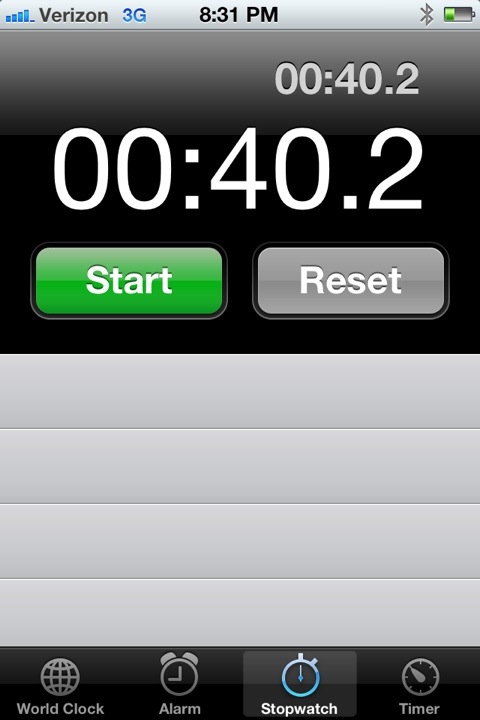
A Fun Game for Bookish Library Nerds

20120518-203142.jpg

1. Go to a library you’ve never been to, or at least never pulled anything from the stacks.

2. Arm yourself with a stopwatch and the call number of a desired book. (Important: confirm the book is actually available and checked in.)

3. Start the stopwatch and see how long it takes you to find the book in the stacks you’re seeing for the first time!

4. Watch as your mother looks slightly horrified and passersby chuckle at you, not with you. Overhear strangers mumbling something about a cameo on Portlandia.

5. When you’ve located the desired book, do a victory dance!

6. Bonus: When checking the book out, brag to the librarians about your time. Don’t forget to pay your library fines!

NOTE: I would just like to say this exercise actually took me 38 seconds, but it took another two seconds to press the STOP button.

Leave a comment

Filed under books

A Readin’ Machine (Or, Squeezed Out)

Earlier this year I set a goal: as a participant in the Goodreads reading challenge, I would aim to read 12 books this year. On April 15th, I met my goal.

Over the last couple of months reading has been my primary downtime activity. I’ve read books in less than 24 hours while waiting for feedback on the latest draft of my project report, waiting for the Portland rain to subside, or just because I was so excited to finally read the thing.

I unloaded much of my library before my temporary move to Canada, but plenty of books remain that need to be read. I’ve read newly acquired books, borrowed books, and library books. I’ve sold a few back to Powell’s since reading them, and plan to continue paring down my library once I’ve read some more titles. This isn’t even including the magazines I’ve piled up, nor the scholarly articles about bikes I found on JStor a couple weeks ago that I want to read just for fun.

A few of the books I’ve read have inspired some wistful nostalgia. Ever since getting back to Portland it seems my brain has soured a fair amount on my hometown. (I’ve a half-written blog post about this, but it’s a weighty topic, likely to be unpopular with most of the transplants I know, so I’ve been keeping it to myself—for now.) Reading three books in a row that reminded me of Portland Past then, was enough to push me into a full-on nostalgia bender.

The first book was Dark Horse’s recent release The Green River Killer: A True Detective Story. Sure, this is a story primarily set in Seattle, but as a Pacific Northwesterner growing up in the 80s, Green River Killer news (also Diane Downs news) was pretty pervasive. When I was a kid, my mother’s favorite books were true crime novels, and I sometimes I picked up her books and browsed the photo plates in the center. Let me tell you something: you cannot un-see some of the photos in those books.

Next was Beverly Cleary’s memoir A Girl from Yamhill. Portland’s own literary hometown heroine, Beverly Cleary was born in the Willamette Valley south of the city but spent much of her childhood in NE Portland, the setting of her Ramona books (and current site of the Beverly Cleary Sculpture Garden). I picked up the memoir at Goodwill for a couple of bucks. So much time had passed since its original release I wasn’t expecting to find it as utterly engrossing as I did. In the book, I discovered that Ramona is essentially based on Cleary herself as a child, and the book includes some very specific incidents that I remember were written into Ramona the Pest.

The book also illuminates moments when Cleary was encouraged by teachers in specific ways that set her on course for her adult career. In one masterfully written passage, she talks about her mother often encouraging her to “try.” When she takes this message to heart and enters an essay contest at a local grocery store. She wins—because no other children entered the contest:

“This incident was one of the most valuable lessons in writing I ever learned. Try! Others will talk about writing but may never get around to trying.” (p. 132)

Given the amount of care I spend on blog posts (and nearly everything else I write), often I wonder why I continue. This is the reason: I am trying. And even if nobody sees my online opining, I’m continuing to develop my writing for future professional writing opportunities.

Where does the nostalgia come in? In the beginning of the book, Cleary writes about Oregon weather masterfully, as if she too has patiently sat through as many Oregon winters as I have, waiting for the spring:

“I stood at the window watching the weather, the ever-changing Oregon clouds that sometimes hung so low they hid the Coast Range, rain that slanted endlessly on the bleak brown fields, stubble stiff with frost, and, sometimes, a world made clean and white by snow.” (p. 30)

Later in the book she paints a vivid picture of Depression-era Portland, peppering the text with references from the past. In fact, at two points she draws attention to phrases Portlanders say, and that’s where the real nostalgia set in. She remarked on Portlanders observing “the mountain is out today.” Of course, “the mountain” is Mt. Hood, being “out” refers to being able to see it on a non-overcast day, and that is a phrase I’ve neither heard, nor used myself, for years. It set my brain on a path of thinking about the ways in which Portland has changed over the past decade as the city has become more notable nationally and internationally.

Perhaps the area of Portland that has changed most in the past decade is NE Portland, and the next book I read just happened to take place there in the 1980s. The Girl Who Fell From the Sky is the current Everybody Reads book at Multnomah County Library, and I wouldn’t have read it had there not been a free copy at the circulation desk of my local branch when I visited. At certain points this book described a place and time in the past that I personally experienced. When the 1988 death of Mulugeta Seraw was referenced as a current event, this book ignited some synapses that hadn’t been fired in years. (If you’re not familiar, read A Hundred Little Hitlers by Elinor Langer.)

Since reading these three titles in a row (pure coincidence!) I’ve moved on to other fare. For a few days though, I was thinking about the Portland Past, both the one I have directly experienced and the one that belongs to my dead relatives’ memory. While I am glad I’ve gotten to know many of the transplants who have arrived in the last ten years, a small part of me feels like I’m being edged out by an invasive species. As the narrator in Said the Whale’s song “False Creek Change” laments about her hometown of Vancouver, BC, “there’s no room for me here anymore, anymore, there’s no room for me here anymore.”

If you’re interested in following my reading habits, this is my page on Goodreads.

7 Comments

Filed under books, history

The E-book as DVD

Deleted scenes are one of my favorite parts of watching movies on DVD. After the feature I see material that was cut for time or pacing, according to the accompanying introduction or director commentary. The cut footage often lends additional information to one of the film’s subplots or a character’s relationship. It’s tough to leave this material out, but including it on the DVD probably provides some solace to the creators.

One of the more intriguing ideas that has stuck with me from MPub lectures is the idea of marketing electronic books like DVDs. In the early 1990s (approximately), consumers were happy to re-purchase all their old VHS movies on the newer technology, despite the added cost, because of “bonus features.” Now, publishers are looking for ways to pay the technological costs of e-book production (and dwindling print sales). In a couple of MPub classes the possibility of similar value-adds were discussed, like short “behind the scenes” films, author interviews, book trailers, and the like.

How do you think an e-book would deal with a deleted scene?

David Sedaris already tests his pieces out on several audiences before they get published in book form. They may appear in The New Yorker, or excerpts may be read at his speaking engagements and notes about audience reaction taken into account as he continues working on the piece. Surely he has taken that feedback and made cuts from time to time.

Writers vary in their process, but it’s also pretty common to edit as you go along, realizing at the end of a paragraph you’ve gone off on a tangent. Writing on computers means these “deleted scenes” could be lost with just a couple mouse clicks, as many writers self-edit as they work.

Would you be more likely to buy a book that had material that had been edited out? If you think you would, consider the case of “What We Talk About When We Talk About Love” by Raymond Carver. One could argue that the “Raymond Carver-ness” of the story is mostly absent in its original form: as seen in the linked reprint, editor Gordon Lish had a lot to do with creating the writing style Carver is known for.

I might be interested in marked-up versions of stories like that only occasionally—mostly for the education to improve my writing, and maybe to remind myself that the best writers are human too.

The value-add that I could see working on me is annotated texts. Great ones exist: my favorite is The Annotated Alice by Lewis Carroll, with notes by Martin Gardner. Considered a classic, the notes explore various mentions in the text. For example, an offhand comment by Alice about walking into a mirror-world yields a discussion of matter (the real world) coming into contact with anti-matter (the molecules in the mirror-world) and why they would spontaneously combust. A particularly specific illustration points out the historical royal the caricature is based on. The poem “Jabberwocky” yields four full pages of information.

In addition to The Annotated Alice, I also own The Annotated Lolita by Vladimir Nabokov. It was my first time reading the novel, but I suspect my appreciation for the work is directly related to additional information illuminated by the notes. And while I haven’t had a chance to read it yet, I discovered the existence of The Annotated Uncle Tom’s Cabin last year while doing research for an MPub paper, and look forward to diving into that novel one of these days.

Folding annotation in as an “added feature” to ebooks may result in that format looking like an average hyperlinked web page, interrupting the reading experience when one is required to click back and forth from original text to notes. Notes in The Annotated Alice stylishly lie in the margins of the book next to the relevant text. Readers could choose to absorb the note, or not, without much more than a movement of the eye.

What sort of “bonus features” would you like to see in the books of the future? Would the inclusion of “bonus features” influence how quickly you embrace ebook technology?

4 Comments

Filed under books

On The Death of the Monkees’ Davy Jones

Davy Jones died today.

This is probably not the proper way to begin, but as a longtime Monkees fan I need to say Davy has never been my favorite Monkee. As a Monkee he seemed perfectly happy playing the cookie cutter heartthrob and didn’t offer much else. Much complexity. Women still swooned over him (rubes!), but this woman has never liked what the crowd falls for so easily.

However, Davy had a considerable talent for musical theater. Pre-Monkees, he was Tony-nominated for his role as the Artful Dodger in the original stage production of Oliver! (The cast performed on the Ed Sullivan Show the same night the Beatles debuted in the US.) Some of Davy’s most memorable Monkee moments come from showcasing this talent in later years before the group broke up—from the “Daddy’s Song” sequence (with Toni Basil!) from the Monkees’ movie Head, to the “Goldilocks Sometime” song in the misguided television special 33 1/3 Revolutions Per Monkee.

Aside from his more musical theater-oriented pieces, he also recorded a single in the 70s which is my all-time favorite Davy Jones song. (Well okay, “Hard to Believe” is an uncharacteristically beautiful piece that I also enjoy.) “Rubberene” tells the story of a man’s relationship with his blow-up doll. If you have a Blip login (I don’t), you might be able to listen to it here. Finally—the one-dimensional heartthrob got a sense of humor! Sadly though, the record is an extreme rarity as it was never commercially released, and by the time the Monkees reunited for their 25th anniversary in 1986, Davy was back to playing his same role.

After that big Monkees resurgence in the late 1980s, Davy Jones also became an author. His first book was a memoir called They Made a Monkee Out of Me (above), and the second book he is credited with is an early Photoshop fantasia (or nightmare) called Mutant Monkees Meet the Masters of the Multi-Media Manipulation Machine (you know it’s from the early days of digital media, as “multimedia” is still hyphenated)When I was in eighth grade, I chose They Made a Monkee Out of Me for a book report presentation. My mom even sewed a Monkees shirt for me, which I wore on the day of my presentation. Being passionate about talking about the Monkees and even dressing the part, of course I got an A. 😉

After reading about Mike Nesmith’s cataract surgery, recently I had been pondering the state of Monkee mortality. As Davy Jones heads to his locker, I am sad to see my wonderings are starting to be realized. It will also be interesting to see what legal battles ensue between Davy’s very young new wife Jessica Pacheco, and the four grown children from his previous two marriages. (Watch them on a train-wrecky reboot of “The Newlywed Game.”)

Davy will be missed, for sure—but I truly dread the day I hear about Mike Nesmith or Peter Tork joining him.

1 Comment

Filed under books, history

The Book of Face: Regional Variations in Approach

Facebook. Blargh.

It’s not an actual book of course, but it seems that a lot of people I know consult it more than real books. After all, nearly everyone is connected to it—if Facebook was a country it would be the third most populous in the world. While I was away over the past year-ish in Vancouver, British Columbia, and Missoula, Montana, I noticed some distinct differences in the way people used Facebook.

In Vancouver, my MPub classmates mostly used Facebook as a procrastination tool from studying. When we had a paper due, classmates would post their word counts as they worked (3578/5000!) or an interesting article from Maclean’s they wanted to share. Photos appeared only occasionally, usually the morning after our post-presentation receptions. At these receptions the alcohol was freely flowing, supplied by our department, which resulted in just a handful of silly photos. Since leaving Vancouver in April, I’ve barely heard a peep from my classmates through the site. We all scattered around the world and started enjoying the summer rather than being chained to our desks. After all, there are real faces out there, and real books. I’ve had some heartening email exchanges, snail mail, phone calls, and in-person visits with my classmates, but relatively little Facebook interaction.

In Missoula, the organization I interned at (Adventure Cycling Association) has a large following on Facebook and other social media sites, but individuals I worked with didn’t seem to use the site much outside of work, and only occasionally there. In fact, they spent most of their weekends exploring the outdoors and connecting with their actual friends in person, rather than from the other side of a smartphone. My thoughtful friend Sarah explains:

One thing I really like about living in Missoula is that we seem to be a little behind in terms of electronic communication. Most people I know don’t have smartphones, and I’d say a fair percentage of my friends don’t have Facebook accounts. It doesn’t make them harder to get in touch with, and it doesn’t make the time we spend together any less important. It just means that when I need to get in touch with someone I actually call him or her, and when I visit with someone I spend more time engaging with her and less time documenting the experience so others can view it.

And home. In Portland, Facebook is a significant topic of conversation at nearly every single get-together I have been at since returning in late September. Friends may talk about what so-and-so is up to, because they read it on Facebook. Or about that simply hi-larious cat video that has been going around. A simple happy hour invitation can’t happen without the site being involved. Photos are regularly taken at get-togethers and instantly posted online. Chatter happens behind the scenes of who has RSVPed to what, sometimes gauging for people whether or not they should go to an event. Groups of people appear cliquish to others when they make in-jokes with each other on Facebook about some trip they took together, or how excited they are for a trip they’re about to take together. Occasionally, someone will call out the obnoxious behavior that the rest of us are doing our best to ignore. The site regularly plays a role in interpersonal dramas. Yes—we are all apparently in seventh grade.

This kind of makes me ill—it’s oversaturation of a single web site in everyday life. Like Kramer from Seinfeld, the site seems to be “a loathsome, offensive brute, yet I can’t look away.” The New York Times recently covered a hip new trend—eschewing Facebook. Sadly, I can’t manage to abandon ship, but now and again I daydream about how much better life would be without it. If you are interested in hearing stories of people who quit Facebook with much good cheer and related success, check out Elly Blue’s site, How I Quit FB.

(Photo courtesy of depone on Flickr.)

2 Comments

Filed under Uncategorized

A Different Kind of 750 Words

In addition to writing every morning on 750words.com, this month I’m also tackling a different kind of 750 words each day.

In order to get my MPub project report out of the way, I’ve broken the word count into a goal of writing 750 words per day, which should allow me to get an official first draft submitted by the end of January!

The final word count needs to be between 12,000-15,000 words including all notes and bibliography. I’ll also need time to work the text into the InDesign layout, and copyedit the document to house style. After being separated for several months, my lovely desk (above) is back to playing its former role as constant companion and trusty sidekick. (Sorry, Atticus! It’s only temporary.)

Big writing projects are challenging for everyone, and I am no different—large word counts overwhelm me and anxiety can start tempting me down a procrastinatingy route (read: hey, let’s write a blog post!). If not that, my brain might hyperfocus on something else—perhaps another problem that I am too impatient to wait for to resolve itself. (Hint: that one has been particularly problematic this time. More than I care to admit.) Once my brain’s focus has been successfully wrestled back to the task at hand things go pretty well. In the meantime though, it’s a tough wall to break through. (Glad I have more success at conquering these challenges than Hyperbole and a Half!)

If you’re interested in charting my progress this month, I’ve created a Google Calendar called “HA’s Project Report Word Count.” I’ve also asked many friends to keep me accountable by checking in with me over the next few weeks about how it’s going.

With your support I can get this thing done!

1 Comment

Filed under Uncategorized

A Solid Year of 750 Words

If you’ve never heard of it, 750words.com is a website modeled after one of the main exercises in The Artist’s Way by Julia Cameron. If readers take away nothing else from that book, they learn about “morning pages“—a writing exercise designed to work out all your mental chatter each morning. The theory is that only after that stuff is out of your head—including the day’s to-do list, negative thoughts about yourself, and so on—your mind is free to create and accomplish.

Cameron insists in the book that morning pages be written out by hand. When I first practiced the exercise in the early 90s, I tried it her way. There were advantages to using my muscles to write things out, but it also significantly hindered how fast I could get all my thoughts down on paper. My brain can chatter like an over-caffeinated monkey!

Apparently I’m not the only person who types much faster than they write by hand—and in this era of cloud computing, it shouldn’t be surprising that 750words.com was born. (Why 750 words? Cameron’s morning pages consisted of three pages, and 250 words per page is industry standard for estimating page count. 250 x 3 = 750words.com!)

Today is a personal milestone: a one year uninterrupted writing streak at 750words.com. I signed up for the site on August 13, 2010, but occasionally missed a day here and there throughout that hellish fall. Starting the day after my birthday though, the words cemented themselves as an integral part of my morning, and I’ve not missed a day since.

A guy named Buster developed the site, and it is supported by small donations from users. One of the fun ideas Buster has implemented include a reward system of fun animal badges based on your writing behavior. They’re motivational, too! Today’s milestone means I finally earned the pegasus with Elvis Costello glasses, which my sights have been set on for the past few months.

Several friends have also registered at 750words.com after hearing me rave about it. They’re not quite as regular as I’ve been, but writing freely and securely has also gotten them through rough patches over the past year. If getting crazybrain out of your head and down on paper sounds like a worthy exercise, I encourage you to check it out as well!

3 Comments

Filed under books

New Year’s Resolution: Kick More Ass

Overall, 2011 wasn’t as challenging as 2010. As the author of The Book of Awesome points out, I got through it.

As for 2012? I’ve never been one for milk, but I do enjoy kicking some ass.

And I’ve never been much for year-marked resolutions. After all, any day could be the first day of a new year! Why put off eating better until January 1st if it’s only October 4th? Why not just create those better habits today?

That’s why my only hope for 2012 is to kick more ass. That’s right—more. Because in 2011 I’ve done many great things.

I’ve still got big challenges, but focusing on the couple of ever-sucky situations I can’t control doesn’t get my thesis written. Doesn’t help me get an income before Sallie Mae comes knockin’. Doesn’t keep my life moving forward in the right direction.

Will it be important, in twelve months, to publicly itemize the ways in which I kicked ass this year? Unlikely. What is important here is to wholly embody the ass-kicking spirit—and that is what I wish for you too, dear reader.

2 Comments

Filed under books

A Girl You Should Date

You will smile so hard you will wonder why your heart hasn’t burst and bled out all over your chest yet.

Head over to NonaMerah to read a loving tribute to a girl you should date—the one who dedicates her time to books.

Leave a comment

Filed under books

What’s the International Symbol for Confusing?

In the days of yore (approximately 2009), Vibram Fivefingers sported a model made out of Smartwool—that warm, user-friendly material known mostly for being made into cozy winter socks. Recently, I purchased a pair of these discontinued Fivefingers to act as an alternate to the beloved pair (Komodosport) I bought this summer in Montana.

Resting on the footbed, a mysterious sticker has been taunting me since they arrived in the mail:


It is unlike any other clothing sticker I have ever seen. The layout is fairly complex for a small sticker (less than one inch square), and the symbols are completely unrecognizable to me.

What were the manufacturers trying to tell me? How to launder the shoes? No. Which religion to choose? No. How to interpret their dreams? Hmm, I hope not.

After puzzling over a couple of days, I thought asking others might help. My first respondent declared, “I have absolutely no idea.” The second respondent, my friend Cat, theorized the following:

Starting from the top left: This is the top of your shoe.This is the inside, where you put your foots.This is the bottom, which is what you walk on.Top right:Now, walk back and forth like this…and again…Yay, we’re done! Diamonds!

An interesting theory, for sure!

Does the sticker have anything to do with why Vibram doesn’t make this product anymore? Perhaps they just couldn’t deal with all the phone traffic, and instead decided to end their consumer-friendly partnership with Smartwool.

Do I need to get a copy of the Symbol Sourcebook to decipher this message? Is it a recipe for a really ripping lentil soup?

Dear readers, do you have any ideas that might illuminate the mystery?

4 Comments

Filed under books