A New Chapter

Just over a year ago, I moved to Vancouver, British Columbia, for the MPub program. Much hair-pulling and stress happened over the few days leading up to the move, but all my immigration documents were assembled, the moving truck was packed, and I was on my way.

As part of the usual process at the border, the Canadian border agent asked me if I had anything to declare: tobacco, firearms, plants.

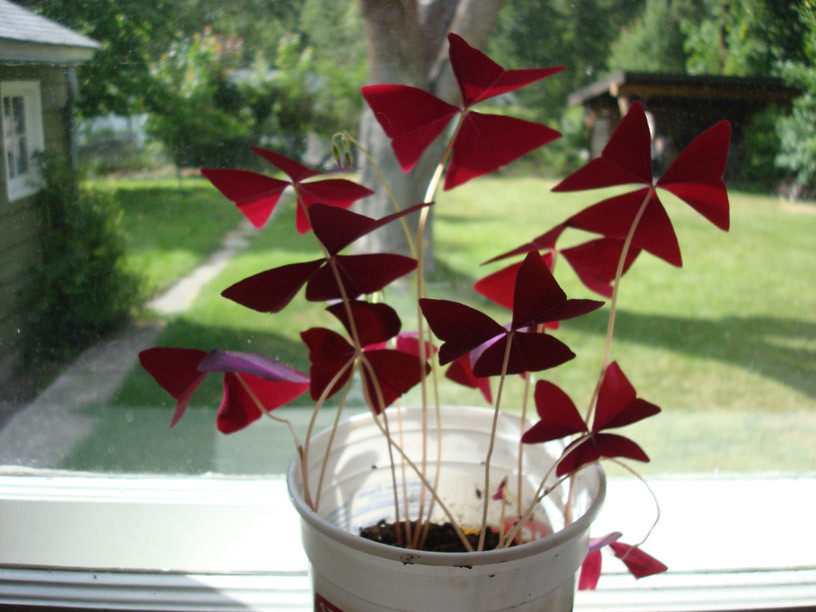
It just so happened that I had a plant with me. The only plant of fifteen, in fact, that I hadn’t given away before leaving town. An Oxalis triangularis, or purple shamrock plant. My favorite plant. A special plant. The leaves folded under at night. It had been propagated in 1997 from a plant that was purchased at the New York Botanical Garden’s annual plant sale.  Until a few years before this I had never seen another Oxalis triangularis, and I still don’t see them often.

Assuming they were concerned with people bringing pot plants into the country or something, I declared my plant to the agent. Honesty is the best policy, right?

Big mistake! After waiting inside the border agency building for my visa to be issued, an agent came outside to inspect the plant. I told her that this was the only plant I had kept of fifteen. That it was special. The agent said the problem was the foreign soil, and the possibility of bad microbes or fungi being brought into the country. I proposed a solution: Oxalis plants have rhizomes—if I removed one of the rhizomes and washed the dirt off, could I still take it with me?

After explaining a second time, I had failed to convince her. Nor do I think she wished to deal with me anymore. She claimed there was no choice because I had already declared the plant (implying I should have lied). She asked me to throw the whole thing into the designated trash can. Even the pot. The pot! The beautiful cobalt pot that the plant had been in for over ten years. It seemed there was no option though, so into the rubbish bin it went.

That hurt a lot, to be forced to throw away something that meant so much to me. But really, there was a lot of sacrifice involved in my getting to Canada. Both intentional and not.

For the first time in over a decade, I didn’t have any plants that needed minding. My apartment was missing something—yet, buying a new plant wasn’t an option, as it wouldn’t be able to come home with me either.

At the end of a rough school year, I moved back to the US. I’d be in Missoula, Montana, for the summer, performing my required MPub internship at Adventure Cycling Association. When my supervisor was taking me on a tour of the building the first day, I saw it. I saw them: two different employees had an Oxalis triangularis on their desk! I made note to ask them about taking a rhizome or two.

Some weeks later one of the coworkers gave me a few rhizomes, which I soon grew into a new plant (above). Near the end of my internship, the other coworker gave me her entire plant, pot and all!

Here I am, having gone from no Oxalis to two, thanks to the incredible kindness of my awesome Missoulian coworkers. I didn’t think the Oxalis could be any more special to me, and now I’ve got a great story that starts with tragedy and ends with generosity and kindness.

After a year away from my lifelong home of Portland, Oregon, I am preparing to go back. Things have certainly changed during this period, and I’ve spent a lot of the summer thinking about what I’d like to see in the next chapter—and more important, how I am going to write it.

As with the Oxalis plant, I hope for a delightful conclusion to the story.

1 Comment

Filed under Uncategorized

Fonzie and Other Montana Celebrities

Yesterday I listened to my beloved Wait! Wait! Don’t Tell Me! podcast, and the weekly guest for their game “Not My Job” was none other than Henry Winkler. You know—the Fonz. Cool, shark-jumping Fonzie. (As well as Yale School of Drama grad [1970], which makes me insanely jealous, as they rejected my application to their dramaturgy program in 2003.)

It turns out that Henry just released a book about fly fishing…in Montana! It’s called I’ve Never Met an Idiot on the River. As he explained on Wait Wait, he fishes in Montana every single summer.

There are a number of celebrities, as it turns out, that have spent time in Montana. My landlord used to work for Jim Nabors (aka Gomer Pyle), whose home is in Whitefish. Andi MacDowell used to have a home in Missoula near the University of Montana, as well as a ranch down in the Bitterroot Valley. Keifer Sutherland and Emilio Estevez used to spend a lot of time around Whitefish—my landlord met Julia Roberts when she and Keifer were a thing. Infamously, the Unabomber Ted Kaczynski lived outside of Lincoln (and I visited his place!). Joe Montana’s son Nate currently plays football here for the University of Montana (which I found out about when he was arrested for drunk driving.) Then there are the notable people who were born here, such as Dana Carvey and David Lynch. Gary Cooper and Myrna Loy lived just a few houses apart as they grew up in Helena.

It seems there are notable people everywhere. Not too bad for a state with a population fewer than one million!

So of course I went directly to the internet to find out where Henry Winkler fishes. Was it near Missoula? Could I meet him? According to this Distinctly Montana article he frequents Firehole Ranch, just outside of West Yellowstone—a five hour drive from Missoula. In fact, the ranch even has a photo of him on their main page!

While I had considered a trip through Yellowstone on my way back to Portland, since summer is over it’s unlikely I would be able to meet Henry. Besides, if I caught up with Fonzie—the coolest guy on the planet—I might end up like Tom Hanks, just kinda making an idiot of myself. 🙂

Leave a comment

Filed under books, television

“Beyond the Gate” Now at Multnomah County Library!

Quite by accident, this morning I discovered that I am listed on WorldCat, a worldwide database of library holdings that are often used to secure interlibrary loans. Now, in order to be listed on WorldCat, you need to be held in a library…

And that’s how I discovered that Multnomah County Library has eight copies of my zine, Beyond the Gate: An Ethnic History of Portland’s Chinatown and Nihonmachi. And as of this morning, four of the seven circulating copies were marked as either checked out or recently returned. Whoa!

That’s right, I’m held in one of the highest circulating libraries in the United States. No autographs, please!

The larger mystery is how the library got eight copies—it sure wasn’t through me. Right before I left for Canada last August I dropped off a single copy at Central for their zine librarians to peruse, thinking if they were interested they’d contact me about obtaining more copies. I never heard a peep.

This could explain why my zine keeps selling so well at Reading Frenzy. The listing dropped off the Powell’s database several months ago, and I assumed this was because it hadn’t sold—but perhaps they all sold at once, to one person! I’ve sent an email to inquire what I can. Perhaps the librarians navigated to this blog, saw where they could pick one up without hassle, and took a walk on their lunch break.

It’s a real mystery, and I plan on solving it. It might require some legwork that can’t be done until I’m back in Portland, but that’s only a couple of weeks away. (Sure, I could email the zine librarian—but where’s the fun in that?)

Another take-away from this discovery: I’d better get cracking on producing my second title!

1 Comment

Filed under history, zines

Bicycling Buffalo Soldiers

Since I am both Bookish and Bikish, every so often something will pop up that requires deliberation about which blog is more appropriate. Blogging about bike books: more bookish, or more bikish? Should I be cross-posting? Do I need a policy, or can my policy for the moment be dictated by my whimsy? Thoughts? At least for now I think I’ll post here, since Bookish gets more traffic (hello, spambots!) and Bikish is still finding its audience.

This summer I’ve been living in Missoula, MT, interning the the publications department at Adventure Cycling Association. My internship is now officially over, but I’m wrapping up a couple of projects—including a short film that will be featured as the last blog post of my series “Backstories,” about bike history.

Adventure Cycling is certainly a cool piece of Missoula’s bike culture, but in my opinion, not the coolest. Earlier this summer Atticus and I spent a day at Fort Missoula and learned that Missoula was home to the 25th Infantry, a group of African American soldiers. In the late 1890s, the unit was tasked with experimenting with the newfangled safety bicycle to assess it for military use.

The Historical Museum at Fort Missoula has embraced the unique story they can claim that no other Army fort is able to. One section of the exhibits is dedicated to the bicycling soldiers, and include an interactive that puts visitors on a bike with 75 pounds of gear. In the store, the museum sells T-shirts and magnets with “Fred E. Fox,” a bicycling soldier. For those who are curious beyond the artifacts and interactives that the museum exhibits have to offer, the museum sells a booklet (really, more of a zine) explaining the experiments in more detail.

It’s a quick read, but satisfied this cyclist’s thirst to know more. Contextual information was included about how the 25th Infantry was formed, and how Missoula was a hospitable place for the group compared to other towns. While the unit did different types of experiments with the bikes (formation work, long-distance travel, and front line message delivery), the booklet focused mostly on their long-distance travel, even though it seemed like the least successful experiment.

The soldiers embarked upon three trips: a short trip from Fort Missoula to Seeley Lake; a longer trip from Fort Missoula to Fort Yellowstone; and an epic journey from Fort Missoula to Missouri. The challenges increased the longer the distance traveled, and the booklet outlines problems stemming primarily from the lack of good roads in the United States. Unfortunately though, before the good roads movement made any headway, the soldiers’ next trip was cancelled due to the unit being sent to fight in the Spanish-American war. (Why were they deployed first? The theory was African American soldiers were not as susceptible to the tropical diseases in the Philippines as caucasian soldiers would be. Not true!)

Eventually the unit was transferred out of Fort Missoula and into a more racially-charged community in Texas. What led to the unit being disbanded was a sad shot of historic reality in what was otherwise an inspirational and intriguing story. No spoilers, though—you’ll have to read it for yourself.

Can’t make it to Fort Missoula but you’d like to read more? Here’s “The Bicycling Buffalo Soldiers,” an article that appeared in Adventure Cyclist earlier this year. Don’t forget—you can also get the booklet via interlibrary loan through your local library!

1 Comment

Filed under bicycles, books, history, zines

Brilliant Bookish Families

Whenever I figure out that two people I adore are related, I feel pangs of jealousy for members of their family. Have you noticed all the talented families out there creating great art?

• Decemberists’ wunderkind (and Montana native!)  Colin Meloy not only has a artistic wife in Carson Ellis, with whom he is releasing a book (Wildwood) this fall—but a gifted sister as well! Recently Maile Meloy wrote a piece for the New York Times called “Reading and Its Rewards,” which linked books with bikes. A winning combination!

• If you’re not familiar with Mark Bittman, he is a New York Times columnist and brilliant food writer. Follow his blog and you will be drooling on yourself regularly—and the best part is, his recipes are usually fairly simple and able to be prepared by those of us who haven’t attended Le Cordon Bleu! His daughter Kate works for The New Yorker, and in June they produced a video together for the magazine about cooking on Father’s Day.

• Perhaps less modest than the other two families, but certainly more amusing, are the Talent FamilyAmy and David Sedaris. Individually they create very different books, David having earned his notoriety by personal essay and Amy coming to books via comedy, first withWigfield and then her breakout title I Like You: Hospitality Under the Influence. To date they’ve only worked together as the Talent Family once, to write the script for The Book of Liz. Independent projects aside, they often appear in one another’s work: Amy has cameoed in David’s stories and provided voice talent for his audiobook recordings; and David has contributed recipes to Amy, including instructions for the notorious “Fuck-It Bucket.” Even David’s partner Hugh Hamrick contributed endpaper design for Amy’s first book, and usually takes David’s portrait for the back cover of his books.

• The previous families are still alive and working, but the Brontë sisters were another noteworthy bookish family. Writing originally under male pen names, their novels are still considered noteworthy classics of English literature, with compelling stories that continue to enthrall readers more than a century later.

Do you know of any other families where genius runs rampant?

Leave a comment

Filed under bicycles, books, cooking

Jag: Montana Governor Brian Schweitzer’s Secret Weapon

Oregon’s governor John Kitzhaber is a great guy. He unites an Oregon traditionally divided between metro (liberal) and rural (conservative) areas. He has been a cowboy-hat wearing rural doctor, yet he’s a Birkenstock-wearing liberal who has created initiatives for forest health.

While visiting Helena this weekend though, my desire to be a Montana resident skyrocketed due to Montana governor Brian Schweitzer.

What’s Schweitzer’s secret weapon that threatens to steal me away from Oregon, you ask? A spunky little border collie named Jag.

On press releases Jag is described as the Governor’s “constant companion and special assistant.” I asked Schweitzer’s office if that means he’s an assistance dog—I was told no. According to the Helena residents I met, Jag goes with Governor Schweitzer almost everywhere. He helps the governor sign bills. Jag has an email address (jag@mt.gov), which means he must also have some administrative assistance translating and typing responses (no thumbs!).

Jag is even the subject of a children’s book: First Dog: Unleashed in the Montana Capitol. In the great tradition of dog biographies such as Millie’s Book, Seaman’s Journal, and even Virginia Woolf’s Flush: A Biography (about Elizabeth Barrett Browning’s dog), the book is great fun and features strikingly real art, down to Jag’s two-colored eyes!

Over at the Montana Historical Society, just a few blocks from the Governor’s mansion, word is that Jag can sometimes be a little protective of the governor—true to his border collie nature. When the Governor came to an event at MHS, Jag couldn’t go into the exhibit area and was not terribly happy about it.

Schweitzer’s office has a postcard sporting a photo of him with Jag, for mega-fans like me. Call during normal business hours—they’ll send you one! They even rubber-stamped Jag’s pawprint on the back of mine. If I had time to return to Helena in the next few weeks before returning home to Portland, I think my goal would be to meet Jag.

Border collies aren’t my favorite breed, but they’re a short step away from my beloved Australian shepherds. The two breeds share many physical and behavioral characteristics, from sporting two-color eyes and a huge smile to the “velcro dog” phenomenon. (That’s what Aussie owners call it when our dog won’t leave our side.) Jag seems like he is a great little dog.

Kitz, unless you’re planning to get an Australian shepherd, Schweitzer wins this round—paws down.

3 Comments

Filed under books, dogs

Midwestern Bible: Preachin’ the Chicago Manual of Style

Senseless bickering is one of my least favorite things to be around. And in the MPub program, if there was one way to guarantee a testy exchange, it was to insert an Oxford comma into a group project document. Even if you were the designated copy editor, other group members would alter the source document to reflect your changes, and varying personal styles within the group would soon come to a head. A heated five minute discussion could be born out of whether the word is free mason, free-mason, or freemason. (Bonus point if you noticed the Oxford comma in that list!)

It’s not like that in the real world though, right? RIGHT?

Sadly, I’ve encountered institutions saying that they generally adhere to a widely-accepted style (usually Chicago Manual of Style or AP Stylebook), when practice may indicate otherwise. Unless they have a written style sheet of their own, or at minimum can explain what their rules are to you, it becomes very difficult to edit copy for consistent style. Then there are the places where different departments use different standards and don’t talk to each other about it…!

Perhaps the bickering wasn’t so bad. At least that meant that people were informed and truly cared.

As you may be able to tell by the photo, my preferred house style is Chicago. Since 2003 I’ve spent a good deal of time working with the book and familiarizing myself with the details of their approach. One example: researching various approaches to how minority groups are named (African Americans? African-Americans? Afro-Americans? Blacks?) for the curator of a high-profile, potentially controversial museum. Chicago’s goal is academic clarity—a goal I can get behind—whereas AP style was born of a desire to save space and use less newsprint.

After spilling blood, sweat, and tears familiarizing myself, I’ve become pretty passionate about the Chicago Manual of Style. Thus, my pet name: “Midwestern Bible.”

So what do you think happened when I recently saw an early edition of Chicago, titled A Manual of Style with Specimens of Type, at a Missoula thrift store?

I gasped. I snatched. I read the tag. A green tag—that means it’s 50% off today! Meaning this baby’s only…$1.50!

Now, I already have far too many books. On this day, I justified the purchase by telling myself I knew plenty of other people who would be wild about getting this as a gift if I decided to part ways with it. And yet here I am, taking photos of this early edition of Chicago to make it look like it has a halo. Here’s a photo of the stylized bookplate in the front. And here’s one of the many pages of type specimens. And the original purchase information. And a page of University of Chicago Press seals! It’s a gorgeous book—being the grandfather of my well-loved reference book makes it even sweeter.

Something tells me I won’t be getting rid of this one for a while.

3 Comments

Filed under books, history

My Experience in MPub: A Haphazard FAQ for Prospies

Over the past few weeks, I’ve been contacted by a few prospective students of the Simon Fraser University MPub program, asking me questions about the program and my experience in it. Last night I was typing another novel-length email and an idea struck: what if I consolidated this information, and built upon it so I wouldn’t be writing the same thing to five different people? Students could read what I (and hopefully my classmates) have to say, then contribute their own questions for me/us to answer.

If there is a subject you’d like to know more about, I hope you will use the comment function to ask more, which I (and hopefully others) will respond to, so future students can benefit from our collective knowledge being gathered in one place. I also hope that my fellow MPub students will feel free to chime in and relate their own experiences as well. MPub professors may not want to read further, as you may stumble across the awful truth as your students see it.

If you’ve been referred here, please know that many of us MPub students really love getting your inquiries and truly want to connect with you and help, it’s just difficult to write detailed emails with all our thoughts when we’re supposed to be working at our internships. 🙂

Here we go!

Q: Tell me about your MPub experience.

MPub is very specifically about the Canadian publishing industry. As a US student who came in not expecting to stay in Canada, this was an aspect I disliked, although I still learned a lot and gained a far more international perspective. I had the choice to attend another publishing program in the United States, but it was at a school that isn’t known for its academic rigor, and there were personal development reasons for me to leave my hometown rather than stay in its safety net. I’ve also heard from a publishing professional since I came back that the other program is seen as more highly literary (and technically, their degree is an MA in English), whereas our program is much more business-oriented. That’s definitely something I prefer.

The program is intense. Your time management skills will be developed far beyond what you ever dreamed possible. There will be an amount of work that is impossible to do in the time you have to do it, and yet somehow, you will get it done. And you will learn that just getting it done is often good enough, because you just don’t have enough time to let your inner perfectionist dictate your work.

The first semester is intense because everybody is freaked out and adjusting to being in the program, and also because the book project is very demanding (more on that below). The second semester is intense because you are constantly preparing seminar presentations, working on obtaining your internship, writing papers, trying to do impossible amounts of reading, etc.

The silver lining: because the program is so intense, you’ll also make some lifelong friends!

On a personal level, I was seriously entertaining quitting the program the first couple of weeks. Some painful stuff happened right before I left home, I wasn’t really prepared to move to a different country, and I took very much to heart the tough talk the head of the department offered at our orientation. There wasn’t a single day the first semester that I wasn’t sobbing at some point, mostly in the comfort of my apartment, but sometimes secretly wiping away tears in the middle of class. Don’t let that scare you though—most of it wasn’t caused by school, and being in such a dark place kick-started close friendships with some of my classmates. The point is, if I did it through all of that, I know that you can do it too.

Q: Any advice for international students?

Going in, I kind of scoffed at the idea of being an “international student” because my lifelong home was just a few hours away. However, it turns out that Canada is like a whole other country! The invisible line is very, very real. At the beginning, professors and students alike were making Canadian references that made me dizzy, zinging past my head too fast to figure out or write down to ask questions about later. It wasn’t until February when I bussed past Duthie Avenue in Burnaby that I realized the lamented closed bookstore that had been discussed all fall semester was Duthie Books, not Duffy Books! Professors made assumptions that we all knew how various things worked in Canada during lectures, which made learning rather confusing [please note: several classmates insist that those lectures were confusing to everyone, not just me]. Fortunately by the second semester I started making good friends, and had specific go-to people I could use to ask, say, how the Canadian parliamentary system worked. Actually for that last one, I wrote a final paper for a class about a failed piece of legislation—it wasn’t until I was almost done that I realized that the bill was dead, and felt pretty silly about even choosing that paper topic to begin with.

If you are an international student, you will likely make close friendships with the other international students in MPub, even if it seems your backgrounds are too dissimilar. Puzzling over something together is very bonding. Hopefully you’ll eventually find a go-to person among the Canadian MPub students who doesn’t mind you asking all sorts of stupid questions so you can figure out their country.

Definitely keep connected with the International Student Office during your time at SFU! Before I moved they helped me with my visa paperwork and answered my questions regarding moving all my stuff through the border; they had by far the best orientation the week before classes started; I got an international student mentor and asked her a bunch of questions about Vancouver when I first got here; and finally, I took advantage of some of the International Student Office outings that allowed me to meet great people from other countries, people from outside my department, have a ton of fun, go to places I otherwise wouldn’t have been able to. One of the most fun things I did in Vancouver was going on a snowshoeing trip organized by the International Student Office in March. If you’re an international student, even just from the US, there is nothing I would highly recommend more than hooking up with the International Student Office.

Q: I haven’t been in school in X years and I’m nervous about going back. 

Yeah, I was too! Most of the students in our class had at least a few years away from school, many with ten or more. The fact is that if you got into the program, the faculty know that you can complete it. At least with our cohort, only about 30% of the people who applied were accepted. You will be among a group of overachievers, and believe it or not, that’s exactly where you belong. It’s not easy, for sure, but you can do it!

Q: What is the average age of MPub students? The brochure says it’s a mid-career program.

In our class (yours may vary!), I believe the bell curve peaked around 27 years old. I was 32 when MPub started, and was the third eldest student in the program. There were also three students, I believe, who had just graduated from their undergrad programs, which was interesting. Several of us expected a little more of a mid-career feel to the program, an over-30 cohort, more discussions based in previous professional experience, that sort of thing—but alas. We all still learned a lot, though.

Q: What should I be studying to prepare for the program? Accounting? InDesign?

Personally, I’d probably put the priority on learning InDesign, because you’ll use it a lot throughout the year. Don’t get too worried: just get familiar with the program. I did so by taking a self-paced community college course the summer before. As for accounting, I probably shouldn’t put this up on the internets, but I still have not completed my accounting book, despite the requirement that we turn them in the first week. However, I had enough super-basic accounting experience from my past ten years of working at non-profits that I was able to get by just fine.

The other thing is that I was given the wrong list of prerequisites, so I initially bought the wrong set of books to study over the summer. It wasn’t until I communicated with another student that the fact came to light. And you will see that these sorts of miscommunications and assumptions by the program that you know something come pretty frequently. The mind will boggle.

Q: What about the book project?

The book project is very intense. Essentially you’re creating a new publishing company from scratch. As you develop your plans, you present before one or two panels of experts each week(!) who give you feedback. Sometimes the panelists give you conflicting advice and you have to decide within your group how to handle it. They call the book project presentation a “rite of passage.” There is a program-sponsored party afterward (with a lot of alcohol!) which often leads to hilarious photos being posted on Facebook the next day.

(The photo at the top of this post is from one of the final meetings of HivePress, the book project group I was in.)

Q: What about the magazine project?

Well, I learned some things I didn’t know before about magazines, and also a new way of thinking about magazines and brands. Nobody who has contacted me seems very nervous about the magazine project, so perhaps if someone has specific concerns I’ll revise this in the future.

Q: What about the tech project? It looks scary.

Keep in mind that you’re not starting the tech project until halfway through the second semester, meaning you’ll have had a solid six weeks of the tech class. This means that you’ll already be familiar with many of the concepts and technologies tackled in the tech project. Also, at least in my experience it’s really more of a project management project. Documentation is key, and John is generally good about communicating with the groups and guiding them along the way. Also, remember: this is a group project, and people often have complementary strengths and weaknesses. You’ll get through it.

Q: Did the program help you obtain your internship?

No. Because I planned to go back to the US for my internship, the program didn’t help me formally whatsoever. (I did have several helpful conversations with my mentor professor, though.) In fact, the head of the department said they wouldn’t help Canadian students get a visa to the US either, so I am the only person interning here.

However, if you are planning to intern somewhere in Canada, I believe the program will help make connections on your behalf if they can. There are a few cases where they need to play gatekeeper. For example, if eight students want to intern at UBC Press, which only has two internships, the program often recommends those they think would be most appropriate. Other than that, students are largely on their own. It’s tough to work on getting your internship while also taking on a full classload in the spring, but they do their best to communicate that you should be thinking about the issue early in the year for best results. Keep in mind that 90% of Canadian publishing happens in Toronto, and because the MPub program is in Vancouver, the publishing companies in Vancouver are up to their ears in MPub graduates.

Q: What was the project report process like?

Here’s a blog post, now that I’m done (April 2012), about my MPub project report.

Q: Did the program help you prepare for a career in publishing?

I’m not sure I’m fully qualified to answer this, for a couple of reasons. First, I’ve been in publishing since I was an undergraduate student at Lewis and Clark College, when I helped two professors on the books they were working on. Also, I’m not out of the program yet, so I can’t really say that MPub has made people line up at my door with job offers. What I can say is that I feel more well-rounded coming out than I did going in, which was one of my goals. And when I arrived in Missoula for my internship, a local book publisher was interested in talking to me in hopes of helping them kick-start ebook production.

Q: Where did you live? Did you have an apartment? Is Vancouver expensive?

Good lord, yes. At the International Student Orientation I believe they said that despite Vancouver being the third most populous city in Canada, it had the highest cost of living. I was lucky enough to find a basement suite a mere mile from Harbour Centre, on the best little block in Strathcona, on a major bikeway (I am a cycling fanatic), a block away from a huge park where my awesome dog and I could walk or play daily. However, I paid for it. I paid $1200 a month to live in a basement. And the landlords easily could have gotten more. At first I intended to entertain getting a roommate, but the bedrooms were so small it ended up being necessary to use the second bedroom for storage.

Groceries are pretty expensive in Vancouver, especially dairy products. A block of plain cheddar cheese that I could get for as low as $2.50 at home cost at least $5.79. Cream cheese could be purchased at home for $3, but at my preferred grocer it was usually $4.75 for the same size. When I came back from winter break, I “smuggled” in three huge blocks of Tillamook cheddar, an award-winning and far superior tasting cheese from home which were a steal at $6 each!

Because I was only living off my Canadian bank account which only had my student loan money in it, I had to be especially tight with money.

That’s all I’ve got for now. Again: if you want something clarified, or if there’s something I haven’t included here, add a comment! Let’s have a conversation that can benefit all.

22 Comments

Filed under books

Everything is a Choice

A Poison Tree
William Blake

I was angry with my friend:
I told my wrath, my wrath did end.
I was angry with my foe:
I told it not, my wrath did grow.

And I watered it in fears
Night and morning with my tears;
And I sunned it with smiles,
And with soft deceitful wiles.

And it grew both day and night,
Till it bore an apple bright.
And my foe beheld it shine,
And he knew that it was mine,

And into my garden stole,
When the night had veiled the pole;
In the morning glad I see
My foe outstretched beneath the tree.

A few weeks ago I was having a discussion with someone, and they mentioned they had taken an introductory course, several years prior, in forestry. One of their main take-aways was that there is really no such thing as letting a forest be “natural.” If you, as a forester, decide to clear out brush to reduce forest fires, that is a choice. Similarly, if you do nothing, that too is a choice. Decision through inaction is still a decision. Both approaches have consequences. Which is why forest management is tricky: it requires balancing the wishes of many stakeholders and trying to be a little psychic, in hopes of doing the best thing for the health of the forest.

Every so often I see rumblings on the internet from people who seem to consider themselves modern zen masters that encourage people to do nothing. Or that sometimes the way forward is actually the way back. Or sometimes the best response is no response at all. And so on. And I agree: sometimes those things are true.

And sometimes, I think some people use the convenience of those koans to justify not pushing past their personal limitations, and thus end up making their decision through inaction. An example: pet owners that fail to get medical care for their dog’s open wound. The show Animal Cops is filled with this sort of thing. When confronted, the owners always have an excuse—but their choice has born consequences. Owners may face animal confiscation or criminal charges, but the most important consequence is seen in the poor animal who suffers horribly because of their owner’s inaction.

Another example, relating to my favorite William Blake poem (from Songs of Innocence and of Experience), is with interpersonal conflict. If you’ve slighted someone, ignoring the whole situation can make the situation worse, with anger festering until it bears “an apple bright.” Recently I stepped on the figurative toes of a couple coworkers—and whereas in the past I would probably think the worst of myself and just avoid talking to them at all, then they’d probably interpret that as dislike for them and a downward spiral would be born, instead I brought one of them a small present, and found some common ground in a conversation with the other.

Lesson? Don’t let interpersonal conflict fester because it’s easier to do nothing, especially with people who are important to you. Even the act of avoiding an important someone sends them the message that they’re not important at all. And that is awesome fertilizer for growing angry apples.

Leave a comment

Filed under Uncategorized

A Visit to Mountain Press

Everyone probably assumes that Missoula, Montana, is not a major center of the publishing trade. And mostly, everybody is right. But despite Missoula only being the second largest city in Montana, a state that doesn’t even have a million people living in it, the town’s not too bad off. In addition to Adventure Cyclist magazine (circulation 40,000), the magazine of the Adventure Cycling Association, there’s the publishing arm of the “conservation” group Boone and Crockett Club*, as well as book publishers Mountain Press.

Last Friday I got to meet up with Mountain Press. They specialize in natural history titles, from their Roadside Geology series to a couple of children’s books I find amusing, called Nature’s Yucky! (“Did you know that…turkey vultures poop on their own feet?”) Their content overlaps a lot with the subjects I was working with when doing museum projects for institutions like the National Park Service and Oregon State Parks.

Mountain Press is one of many small publishers finding they need to get into the ebook game. And they thought that I, a fresh young MPub in Missoula, might be the catalyst to get that project moving. (Meanwhile, I was afraid they were thinking I was the great white hope, and was much relieved to find that wasn’t necessarily the case.) Interspersed between a friendly lunch at The Good Food Store and a tour of the building, we talked about what I might be able to do for them when I’m not running to get Greg Siple another muffin because I accidentally stole his.

I started by offering up a “better practices” guide for ebook production written by five of my lovely classmates last semester, under the group name the ePublicans. It’s available online in wiki form, a downloadable ebook, or my personal favorite, the PDF.

Where will this lead? I’m not sure exactly. In the meantime though, they were gracious enough to give me some of their black and white back stock: Roadside Geology of Montana, and Roadside History of Oregon and Montana. And it was nice to be around people who not only highly respected the MPub program, but had a personal relationship with a couple of my professors. And if that wasn’t enough, I was introduced to my favorite cat in Montana—the extremely affectionate Jack Black the Cat.

*=”We want to save them…so we can kill them!”

Leave a comment

Filed under books, history